 |
| Photo by Kyle Lemle |
The wind was so strong it was clarifying. It came through all cold and quartzite, a wind off northern seas or the tips of faraway mountains laced in ice, and Mt. Vision seemed to rise up inside it, recognizing something of its old and elemental making in such gusts, something from the beginning of time. It came through my knitted coat and woke up all my skin, and Point Reyes, from that vantage, was swept with it, the long ocean shore to the north one great seam of foam, the fingers of Drake's Estero a silver undulation, the hammerhead of the headlands splayed flat under its hands.


Sometimes, a view is precious. Bird's-eye. To stand on a peak and look out over land you love so much (a love that sometimes hurts, inexplicably) it takes your breath and replaces it with wind; to stand and hold it all with your eyes, the valleys and ridges and curves and headlands and long shorelines and estuaries and forests all part of one creature which has come into your body through your eyes; this is holy. This must be why the mountain top is thought to be a holy place, why this one is called Vision. To sense that which is very ancient, older than this shape of Point Reyes, old as oceans; to sense the spread of bedrock, the shift of plates, the seethe and quilt of many different stones below, from the land's long nomad journeys, the way waves mold coasts.
 |
| Photo by Kyle Lemle |
There is another aspect to the perspective that high places give: inner vision. Not of the human psyche (though that may come incidentally, naturally, from these other Visions), but a sense of the innerness of the ridges and valleys themselves. A doubling of vision, holding the pine-skin over the ridges on one level, sensing an incandescence below, like the hills and slopes might be full of shards of light.

Maybe it was in part the wind that made me feel this way as I stood inside of it, taking the estuaries and fingers of land through my eyes into my bones. The way a wind that strong strips things down. The way the world started: before anything, some howling weather, some vast winds whose gases could kill us, searing across stone, whittling it. Maybe these memories are held under the fur the pine trees make, under the topsoil, the rootplace, the tunnels of moles and gophers and shrews, inside the rocks of Point Reyes, and the hum in wind.

This place steps me sidelong into a different kind of time.
Much of Mt. Vision burned in the 1995 fire; you can track the places fire touched by the thickness and age of the bishop pines, which are all twenty years old now, a young eager forest so dense that to pass through it is to enter a dense hush, tunneled, strewn with golden meteors of resin and the ch-ch-ch of ruby-crowned kinglets, foraging tiny spiders.

Bishop pines are dependent on fire to pop open their hard-sealed cones. The fire, though devastating by human terms, was one great cacophony of pine seeds, burning like fireworks, bursting free, nestling into ash to be reborn. There is fire under the surface here. Bishop pines don't live much longer than a century; they expect a rhythm of flame to come through and give them rebirth, a hundred thousand phoenixes from the ash.
 |
| Photo by Kyle Lemle |
So in the tunnels of Mt. Vision, time is made of fire, and though the trees are small and young, this rhythm of burn to ash and regrowth is as old as the trees themselves, which are a very, very ancient species, endemic to particular granitic soils in coastal California which bear remnants of the island chain that was the First California millions and millions of years ago.

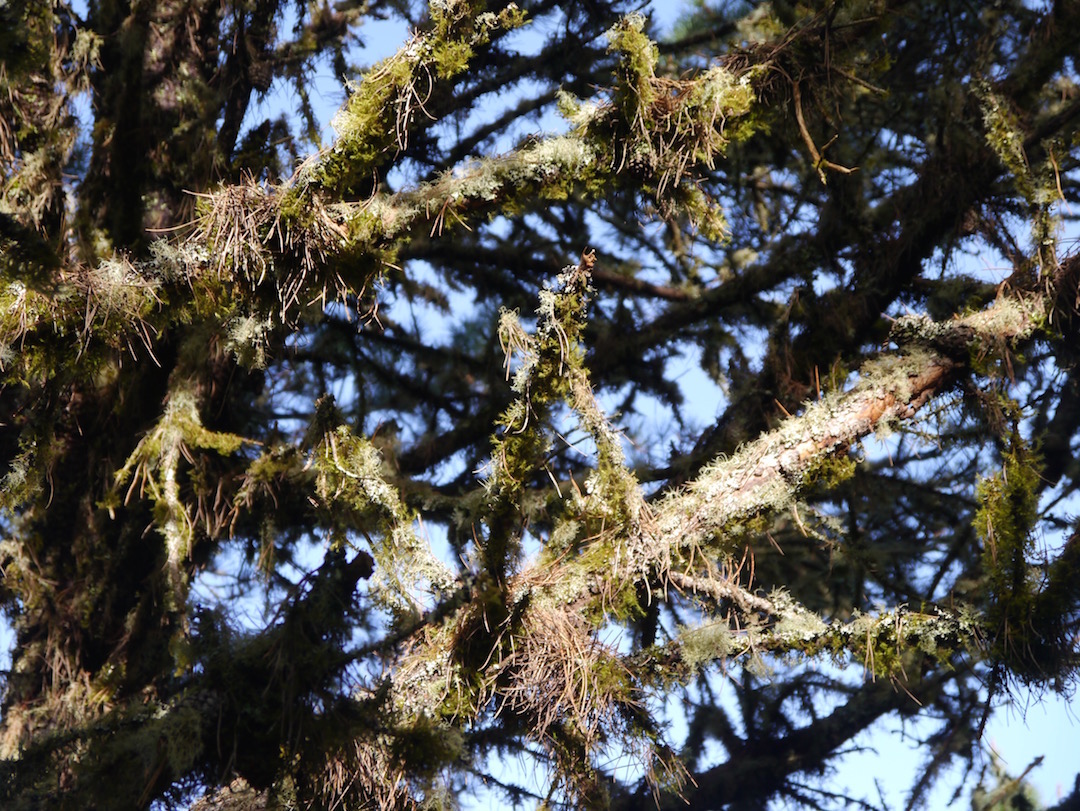
On Point Reyes, they grow where the soil is thick with granite and the air is thick with fog, drinking up that mica below and that drip above through the long dry summer, growing shaggy coats of lichen and moss in the clean, clean wind.

Usnea, an abundant lichen bearding these pines, is a beautiful and potent medicine (for pneumonia, for strep, for virtually any infection in the body, topically and internally), and if you look sidelong, it grows in tiny microcosmic thickets: wee pine trees, girding the pine bark.

I love this mirroring; how the form of forest is held in the eager lichen; how the seethe of foam on the shore is sometimes exactly the same as the seethe of cloud; how one pine seed is also a great red star, Betelgeuse or Aldebaran.


How the pine sap, dripping, is a liquid fire, stalactites, beaded constellations that catch light, bits of pure quartz from the inside of Mt. Vision.

How the woodrat builds its nest like a small mountain, a personal Mt. Vision of tunnels and chambers, some full of obviously useful stashes of seeds and nuts and bits of mushroom, or bay leaves for pest fumigation, others used exclusively for shiny treasures--dropped pennies bright as resin or quartz, silver-capped pens, fallen earrings and bits of necklace; and from older generations
(nests are passed on in families, sometimes for thousands of years), gleaming black arrowheads, lost abalone-shell beads, polished bits of soapstone.

I've never seen a woodrat nest made of bark like this before-- a resourceful fellow (who I left a shiny new penny for, my usual woodrat protocol when passing their castles), who clearly gathered up all the ember-bellied bark from this old bishop pine snag (a fire victim, likely the mother-father of all the surrounding youths) and used it to build his own mountain. Woodrats are known to adorn their nests with all manner of unusual items, apparently for looks alone, such as lost CD's or bones-- so perhaps the pine bark is all turned orange-belly out for a mysterious but important decorative purpose.

There are days when I burn with curiosity at the foot of a woodrat nest-- what is it like inside, when you are a woodrat? With lizards and tiny mice lodging in abandoned wings. With treasuries of penny and bead. What is it like when the coyote comes sniffing, comes pawing like a terrible wind, and you must dash into an underground redoubt and stay very still until the worst is over?

((AN ASIDE: I am suddenly wondering, as I write this, if the mystery paw I found in what I think was coyote scat on the trail belongs to an unlucky woodrat. It definitely belongs to a rodent, with the several distinct metacarpal pads, and not a digger—the claws are too small, unless it's a gopher's back foot— nor a mouse, as this paw was pretty big, about the size of a penny. A ragged little mystery, there, gone through the underworld bowels of Coyote.))

The old fire-seared pine is full of constellations where small woodpeckers once tapped, and one big dark moon, where a pileated came long ago, flashing her red crown, and hollowed a home (which after a season became home to others, one by one—maybe a gray squirrel, maybe a long-tailed weasel, maybe a mouse, an owl, a bat).
How many homes there are tucked deep in the brush, or up in the pine branches, or under the duff-rich soil, of these hills; when I stop and sense and wonder—how many eyes are on me now? how many brush rabbits, bobcats, lizards, foxes, spiders, tucked just out of sight?— the land takes on another layer of luminosity, not the inner kind of fire and quartz, but the outer kind, of warm-blooded life, homing and bright.

The mycelia of it, spreading everywhere, a web of lives— both the literal kind that fruits as rich wet mushrooms, and the metaphoric kind, of the net of relationships between beings, one life folded into another and another via hunger, the hunt, the slow transmutations of decay, the quick fires of love and newborns and feasts on fallen pinecones.

I have returned to reading a lot of Robinson Jeffers recently (after a pilgrimage to his Tor House on the Monterey Coast, a sacred story for another day, connected to another pilgrimage, to England and Dartmoor, also for another day). He is an old inspiration of mine, one of the very first poets who inspired me to tuck my word-seeds into the land, and he is partly to blame for the sudden hold that the "transhuman" has upon my heart these days—the grand scale of things, of stars and cells and mountains and the bright eyes of hawks, the way all life is mirrored within itself, from the tiny cell to the sun, and how it was always so, even when the bishop pine and her resin were only a dream in the belly of a primordial algae.
"I believe the first living cell
Had echoes of the future in it, and felt
Direction and great animals, the deep green forest
And whales' track sea; I believe this globed earth
Not all by chance and fortune brings forth her broods
but feels and chooses."
- from the poem "De Rerum Virtute," in the collection Hungerfield.

In this autumn blaze of sunset on the wind-seared Mt. Vision I watched a red-tail soaring, buffeted, star on his wings. I saw three kestrels, shards of arrowed light, tossing and veering and crying out, chasing him, and for a moment I was their feathers, scrimmed with wind; I could feel their lightness of being, the ferocious and radiant purpose of wings and beak, the absolute joy of such soar. Then the feeling was gone, and I was myself again, below, watching the kestrels, the hawk, the sun on old pines, the land reaching out its hands to the ocean, shaken.
But is there anything sweeter to the tongue of the mind than for a moment to be lost in kestrel-flight?

There is no one to say it better, so I will leave you in Jeffers' hands:
"One light is left us: the beauty of things, not men;
The immense beauty of the world, not the human world.
Look—and without imagination, desire nor dream—directly
At the mountains and sea. Are they not beautiful?
These plunging promontories and flame-shaped peaks
Stopping the sombre stupendous glory, the storm-fed ocean? Look at the Lobos Rocks off the shore,
With foam flying at their flanks, and the long sea-lions
Couching on them. Look at the gulls on the cliff-wind,
And the soaring hawk under the cloud-stream—
But in the sage-brush desert, all one sun-stricken
Color of dust, or in the reeking tropical rain-forest,
Or in the intolerant north and high thrones of ice—is the earth not beautiful?
Nor the great skies over the earth?
The beauty of things means virtue and value in them.
It is in the beholder's eye, not the world? Certainly.
It is the human mind's translation of the transhuman
Intrinsic glory. It means that the world is sound,
Whatever the sick microbe does.* But he too is part of it."
- the last verse of "De Rerum Virtute," in the collection Hungerfield.

* the "sick microbe" is us, for those not versed in Robinson Jeffers' worldview. Harsh it is, but I always have been greatly relieved by his great epochal, geological outlook, his hawk-sharp criticisms. He was, and is, controversial for it.


