 |
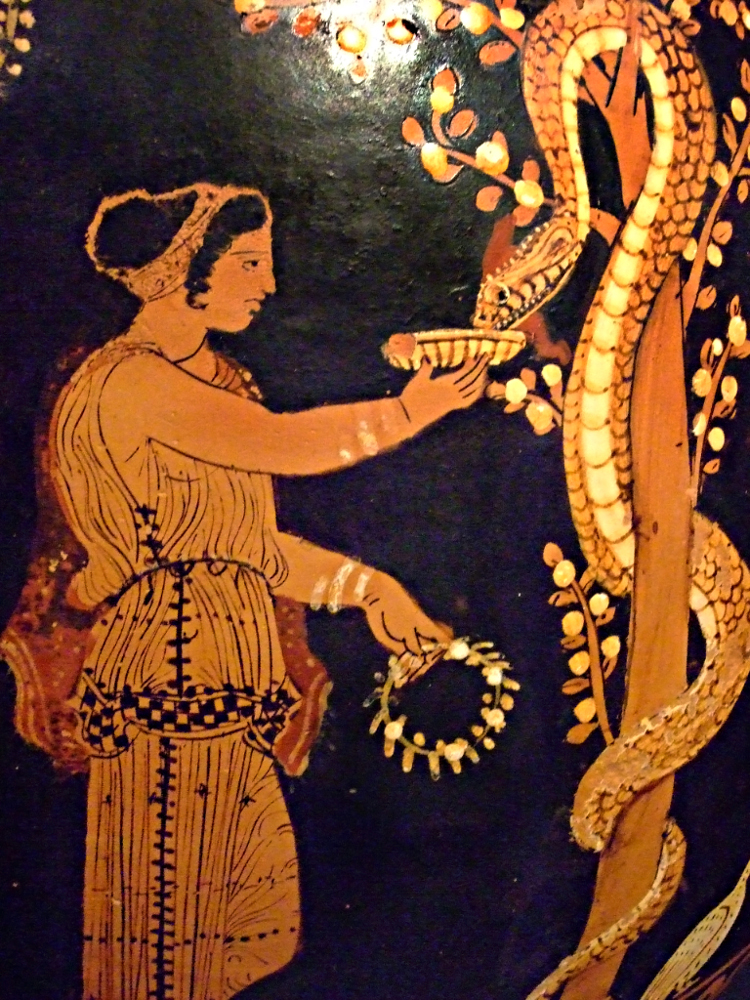
| Greek lekythos (oil jar) detail of a woman in the Garden of Hesperides, feeding one of the sacred snakes who guard the golden apple trees there. Made in Paestum, Italy |
The First Dragons
When the Earth, deep-coated with the slime of the late deluge, glowed again beneath the warm caresses of the shining sun, she brought forth countless species, some restored in ancient forms, some fashioned weird and new. Indeed Earth against her will produced a Serpent never known before, the huge Python, a terror to men's new-made tribes, so far it sprawled across the mountainside. The Archer god Apollo, whose shafts till then were used only against she-goats and fleeing does, destroyed the monster with a thousand arrows, his quiver almost emptied, and the wounds, black wounds, poured forth their poison.
- from "Apollo and the Python" in Ovid's Metamorphoses
These days, whenever I come upon a snake or a dragon in an old story, I see the tracery of something ancient. The key to a lost door, a track in the sand of things that points straight back to indigenous ground. Earth's ground. A red flag of sorrow stands there, from a forgotten battleground.
When you see a dragon slain in a fairytale by a good knight, look again. When you see Medusa beheaded, Tiamat defeated, the Python of Delphi dismembered, the snakes banished from Ireland, the evil serpent guarding the apple tree in the garden of Eden, look again. That Serpent made by Earth, whom she supposedly never knew before? That "huge Python, a terror to men's new-made tribes"? She was anything but new. She was the oldest deity of all, but making her a him and making him monstrous domesticated the power of what had been told before.
These are stories laid over older stories. They are dangerous in their power. I love stories, but I also fear them equally, because a story can destroy through centuries what a single sword or even an army cannot. We in the west have inherited a demonized snake. We have inherited a virgin-stealing dragon who ravages whole towns. Little do we realize that these are colonized stories. They are stories told by those who conquered, who wanted to kill what was most sacred or take it for their own. Because of its very power, its potency in the imaginations and hearts of the women and men who worshipped thus. You cannot truly kill the Python of Delphi, not with a real sword. But with a story you can, until no one remembers the older one, the older name Drakaina. Then, the conquest is complete.
 |
| Proto-Attic snake pot, Athens, circa 650 BCE. Courtesy of Max Dashu's Suppressed Histories Archives |
In Homer's Hymn to Apollo, the serpent is no male python, but drakaina. Demonized still, but female—nearby was a sweet flowing spring, and there with his strong bow the lord, the son of Zeus, killed the bloated, great she-dragon, a fierce monster wont to do great mischief to men upon earth, to men themselves and to their thin-shanked sheep; for she was a very bloody plague. Ancient traces slip through the lines of later histories, poetries, plays. Drakaina was the daughter of Ge, Gaia, Earth herself. The snake lived coiled deep in the ground beneath the Oracle of Delphi, Navel of the World. Back then the holy place, that Grecian omphalos, Center of the World, was called Pytho. And Pythia continued as the name of the female oracle at Delphi even after Apollo's takeover. The woman and her snake. She prophesied from her adyton in the sanctuary where two fault lines met and exhaled chthonic gases. She sat on a tripod, holding a laurel leaf and a bowl of spring water, and became entranced. Her utterances were rhythmic, an old and fearless poetry. They say her inspiration came from the breath of that very chasm; the whisperings of the Python, Drakaina daughter of Ge, daughter of Earth.
 |
| Apollo and Python, Athenian black-figure lekythos, circa 6th B.C., Musée du Louvre |
It was not always a safe wind. Modern geologists believe that the grinding of the two limestone faultlines below Delphi produced methane and ethylene gases. Ethylene smells sweet, as many of the ancients described the breath of that underground oracle, and produces mild euphoria and a floating feeling. But it is dangerous too. The Pythias always made a ritual approach; tested the space with a goat-sacrifice; watched her skin shiver under the ritual libation. If it did not, the prophesying could not go forward. Who knows what strange canary-warning the goat's skin made, or why. Plutarch tells the tale of one priestess forced by priests to sit upon her tripod in the fuming adyton despite the failure of the goat to shiver, despite her protestations, despite her terror. Shortly after, she fell down dead. Earth's winds, her sacred breaths, were not to be handled lightly. Snake-tongued are the old tectonic plates, life out of death, death from life, a never-ending circle. So the first Oracle might have sung there in the dark ground, dreaming of the dead and of the distant living yet to come. Of us, at the ending, at the beginning, at the place where the snake is eating her tail.
A speaking earth, a sacred snake, the power of prophetic women. This is not easy to kill, and yet all through the stories, threaded like a bloody red string, we find their deaths.
 |
| Laurel leaves & berries, from an ancient stone path on the island of Ithaca (c)2016 Sylvia V. Linsteadt |
Recently I've noticed talk of serpents among writers and thinkers who I very much admire. Some of what has been written troubles me, the suggested equation of the rise of Trump & similar horrors as an exiled serpent's return. Perhaps I haven't understood the whole argument or the whole story, but this sounds a little bit too close to the rise of the stinking Python who Earth bore unwillingly, who would have destroyed us all if not for Apollo and his sword.
A slightly different way of thinking about serpents has been coiling around in my mind since last September, so I thought I'd offer it now, to add another layer to the conversation, keeping my focus narrowed on the Greco-Roman world, as it carries the root of many of our narratives & mythological tropes to this day. For I'm weary of beheaded dragons. They fill me with sorrow for what we have lost. I'm weary of the serpent in the garden. The evil virgin-eating wurm. The snake was never our enemy. The man with the sword and the rapist's eye; he was.
We have certainly exiled the serpent as a culture; we have driven her deep into the caves, hidden her deep in her native underworld, where she has been largely forgotten. But I don't think her return is the rise of Trump, or even the more general rise of what is ugly and mean and monstrous in us. I would like to free the snake from her long-suffered monstrosity. Before, she was Earth's daughter, holy and revered. I think the rise of the snake is the rise of Earth herself, both in her terrifying aspects—drought, flood, hurricane, earthquake, disease—and in her gentler gifts, manifesting through us in our work with food, soil, seed, story, song, paint, clay, herbs, animals, and each other. It may very well be true that the serpent has returned from long exile. Certainly she has come slithering through my own psyche, demanding to be written. But I do not think it is she who will destroy our kingdom. We've done that ourselves.
 |
| Cadmus, Harmonia and the Ismenian Dragon, Paestan red-figure krater, circa 4th B.C., Musée du Louvre |
Drakaina
It all began a year ago last June, up in the dry golden hills of Mt. Tamalpais, among oaks and bay laurels and the calls of acorn woodpeckers. There, I came very close to stepping on a young rattlesnake, curled for a nap by a warm log. That day something serpentine entered my life, and I've been following its traces ever since. At first I didn't know I was following anything at all. What I was following lived far, far down in me, coiled, subducted, but still alert. It took a journey to Greece to uncover it fully, because in the limestone bedrock of that ancient land the snake still speaks. She never quite stopped being revered. And what she has been saying since the beginning of time is of the utmost importance to us now.
 |
| Polis Cove, on the island of Ithaca (c) Sylvia V. Linsteadt 2016 |
We went in September, to the island of Kefalonia in the Ionian Sea, to visit my partner's brother and his family. I spent mornings sitting out on our tiny balcony looking into an olive grove, writing. I left milk and grappa in the lines the sunrise wrote on the gentle waters of the Ionian that lapped just beyond our front door. Sometimes I went for dawn swims. Always, for afternoon swims. The Ionian is very salty. It buoys you up without effort. Drifting, my mind learned many things. Writing, those things came out. Writing for me is a kind of awake dreaming. I discover when I write, chthonic worlds from deep inside myself and sometimes, when I least expect it and when I am not trying at all, from the earth. Snakes began to appear in my writing and in our daily journeys. So too did strange underground riverways. Serpentine places.
We visited a cave called Drakaina on the southern edge of Kefalonia, so named, people said, because the cliffs around it seemed to have been scratched by dragon-claws. She-dragon. Later I learned that drakaina was the first and oldest name of the Python of Delphi. It was a small cave, a humble one high up a cliff where a whistle echoed forever back and forth between the limestone face of the gorge. Simon reported this to me after climbing all the way to the top; I made it only halfway up, panicked by the height and the sheer slippery cliff. This was no tourist destination and certainly not a safe ascent; when the old men at the village bakery finally understood the place we were trying to get to and directed us, they laughed and looked at my leather sandals and said something to the effect of you'd better hold onto the branches. Little did I know at the time that they meant this very literally; there was nothing else to hold on to but the springy branches of brave young oaks growing sideways out of the limestone. So while Simon actually ascended the final bit, and whistled to the rocks, and climbed through the chain-link fence to see the cave, and brought me down a piece of sage, I crouched clinging to the cliff on crumbling stone, holding a little oak tree's hand, my legs shaking uncontrollably, muttering my apologies and my reverences to that old drakaina.
 |
| Athenian snake goddess votive offering, found in the Agora but date of manufacture unknown, pre 7th century BC |
Archaeologists have found female figurines tucked away in the Drakaina cave from as far back as the Neolithic, and offerings to nymphs and to Pan up through the Classical period. But in the name Drakaina perhaps resides the cave's most ancient truth. The oldest female deities of indigenous Greece almost always have snakes by their sides. In a sense, they are snakes, for the snake is the earth speaking, the earth manifest. Life-force, endlessly creating, dying, and being born again out of the darkness. Underground the seed always carries the light of new life, even through death. The snake teaches this, whispers it, sheds her skin and lives again. So it was in the beginning, before Zeus. So it will be at the end.
 |
| Poros Gorge, site of the Drakaina Cave, Kefalonia. (c) Sylvia V. Linsteadt 2016 |
I started writing a story those Kefalonian mornings while looking out into the olive trees. I did very little research about any of this at the time. I wanted to be a clean slate. I wanted to let the air and the stones and the sea talk as directly as possible to me and through me, without my mind overlaying them too much with what it wanted to see. What came out was a novella full of snakes and full of underworlds. I thought I'd discovered some old secret. Something hidden deep under the surface of that limestone land. That my sudden obsession with snakes was some kind of revelation. Don't we always harbor a few secret egotistical fantasies that we will be the first to have thought of something, to have seen the connections between things? And yet in the end it matters little, for it is that very process of discovering something entirely for yourself, right up from the earth, that is so moving; and to find that others have done so before you is in fact a great comfort, a delight. For when I came home and began more serious research into the iconography of the snake in the ancient Mediterranean world, I had to laugh at myself. I discovered that the important question is not was the snake important in ancient Greece but where was the snake not revered in ancient Greece? Or, in other words, when did the snake stop being at the center of religious ecstatic practices and become a monster that needed slaying instead?
The Beginning
Traces of the sacred serpent are everywhere across the pre-Indo European landscapes of Europe, Asia Minor, North Africa and the Middle East. The shape of rebirth in a shed skin. The serpent eating his tail in the endless round of seasons. The buried seed, reborn. The energetics of tectonic chasms, earthlines, underworlds, subterranean waters; their rise and fall, their undulations, their fertility. In our earliest days as ancient humans and Neanderthals, we lived in caves, in their safe and cool darkness, womb-like and near. There, snakes both real and mythic still dwell, in the dark of those mysteries. Dragons too. In fairytales we are taught they guard their treasure jealously in such caves, but perhaps the treasure they have guarded all this time is not the gold and jewels of kings, and their ferocity not evil or demonic but simply necessary. Necessary so that they might survive all those eons alone, all those eons demonized and hunted; so that they might return at last from the inner reaches of our imaginings to the surface again, bearing the treasures of an underworld we turned our backs on while we were busy trying to live forever, busy trying to get to a kingdom in the sky.
 |
| Grotto dei Vallicelli, Mount Cilento, Italy (c) Sylvia V. Linsteadt 2017 |
In Lithuania, snakes were actively revered all the way through the middle of the twentieth century, and surely still to this day to a lesser degree. "They occupied the place of honor, the sacred corner of the house, and were fed milk in addition to their regular diet. The snake protected the family, or more exactly, symbolized its life force. [...] Peasants celebrated a sacred day of snakes (kirmiu diena) around January 25, when snakes symbolically awakened and abandoned the forests for the houses. This special day marked the beginning of everything, the awakening of nature. On this day farmers shook the apple trees so that they would bear fruit, and knocked at beehives to awaken the bees." (203-204, The Living Goddesses, Marija Gimbutas). One can only infer that this was the continuation of an unbroken reverence from a very distant past; for something so pagan as snake-worship would not have actively arisen within the confines of Christianity, but rather would have remained a kind of fertile marginalia from long ago.
 |
| Cucuteni storage jar from Neolithic Ukraine, painted with serpentine forms, circa 4500 B.C. |
The temples and pottery of earliest Neolithic Europe abound with snake imagery, and probably abounded with live snakes too, kept there by priestesses. The most obvious remnants of a pre-Olympian Grecian culture, an indigenous Aegean culture perhaps, can be found on Crete among the ruins of the Minoan civilization (named for King Minos in whose labyrinth dwelled the sacred bull, and whose daughter Ariadne danced that labyrinthine ground before ever it was a trap for fresh young bodies, its bull a demon and not a fertile god). There's no getting around the abundance of potent snake imagery in those old Cretan artifacts. Most famous among them I think is the sculpture of the"Snake-Priestess" from Knossos, her eyes wide and staring in trance, a snake in each hand.
 |
| Cretan snake goddess/ priestess, from the palace of Knossos, Heraklion Archaeological Museum |
Other Cretan sculptures and frescoes show women variously crowned, carrying or cloaked in snakes, and the beautiful golden seals which bear strange and potent visions of lost women's ceremonies often depict snakes rising in little zigzags through the air, as if indicating altered states, lifeforce, vision, or perhaps all three. But even by the time of their depiction in gold, clay and rich ocher paints alongside the exquisitely-adorned ladies of Crete, the relationship between women and snakes in Greece was doubtless already very old. As old as the hearthfire in the center of the oldest cave. It was a language spoken in symbols, a language older than words. A symbolic narrative that continued like a subterranean river through the iconography of the Classical Greek and Roman worlds, and managed to survive within the Virgin Mary herself. Carefully crafted narratives might have told one story, a new story, the story of the serpent slain and buried, sent back to the dark where it belonged, a newly demonized dark. But in the sculptures and in the paintings, a different story persisted. The snake stayed beside the woman, her companion, helper, healer, protector. He is there still.
 |
| Ancient Cretan Seal depicting women in ceremony with a double axe, crocus flowers, two snakes floating past the sun and moon, a fruiting tree. Courtesy of Max Dashu's Suppressed Histories Archives |
Around Christmas this year, my younger brother and his girlfriend got a pet snake, a miniature Australian python. They are reptile lovers and have been since they were children; I knew it was a good match when I saw them both run gleefully after a fence lizard at the same time, just to cradle it in their hands for a moment and exclaim over its beauty before letting it go. Hearing that they'd gotten a pet snake, I, deep in snake-writings and serpent-dreamings already by then, excitedly told them they should name it Pythia, tumbling out the whole tale of the Delphic Oracle. This, I think, was perhaps a bit much. Sometimes our privately researched obsessions and passions don't quite translate to others when we speak them out-loud, bright-eyed and messy-haired, fresh from the studio. In any case, they named her Lulu, a more suitable name for the gentle little creature that she is.

The first time I held her she went straight up my shoulder, around my neck and into my hair, which I mostly wear in a coiled bun. At this, my brother exclaimed that she liked women much more than men; she was more comfortable with us, and would always slither straight up into our hair, perhaps enjoying the safety that longer locks provided. She would have sat up there in my hair all day if I'd let her, her head just peaking out next to my ear, her tail coiled firmly out of sight. Medusa, I thought to myself. I thought too of the ancient women of Crete, the snakes twining their arms. Of Athena and her snake-cape. Before actually holding Lulu and letting her coil around on my head, I'd found the idea of actually carrying snakes like that a bit alarming. I wasn't expecting the profound and simple pleasure of her cool, slithering body tucked safely in my hair, the rippling of scale and muscle and vertebrae as she moved, sticking herself right to my neck, the calm her presence brought. I think she enjoyed it as much as I did; the warmth, the company, the kinship. We seemed to understand each other, strangely and simply, across that species-divide which sometimes feels so vast, and sometimes no wider than a single layer of skin. And I felt with a strange clear knowing that I could understand the women in the frescoes a little bit better; how, snake-haired, something in them slanted, opened, saw.
 |
| Cretan fresco of a woman with an offering, possibly pomegranate pips. She appears to have a serpent atop her head. Courtesy of Max Dashu |
The Sibyls of Campania
 |
| The Asklepion of Teggiano, now a church (c) Sylvia V. Linsteadt 2017 |
At the ancient dream temple of Teggiano, the sibyls buried their snakes in urns and put the urns right inside the walls. The walls are held up not by limestone and ash-plaster alone, but a writhing weave of snake-ghosts. So it seemed to me when I visited the temple this past April with Gail Faith Edwards, and sat upon the ancient center-stone where down below rested the bones of thousands of years and the memory of the first ones who worshipped here, who loved their snakes as friends and guides and mourned their deaths. The walls seemed to seethe with golden snakes. The floor too. Far below I felt them. Reverence still pooled there, in the stones, in the walls. The memory of worship and of love.
 |
| A snake-urn in the wall of the Asklepion of Teggiano (c) Sylvia V. Linsteadt 2017 |
Such places were called Ascleipions, sacred to Asclepius, Greek god of medicine and bearer of that famous snake-twined staff that we still see as the symbol of the medical profession today. Cults of Asclepius were very popular across the Mediterranean world from the 5th century BC and onward, and Ascleipions proliferated, making their way as far as Teggiano and all across southern Italy, which was then known as Magna Grecia.
 | |||
|
But as you know by now, you can be certain that wherever you see a snake, especially a healing snake, it's worth looking again, lifting a few layers, seeking roots. Asclepius, as it turns out, was the son of Apollo and of Coronis (sometimes known as Rhea Coronis, Rhea who is daughter of Gaia and a Titaness), who was killed for being unfaithful; Asclepius was rescued from her womb just before the funeral flames engulfed her. Not a promising start, if you ask me. But interestingly familiar. More interesting yet is Asclepius' slew of daughters, all of whom were goddesses of healing in their own right. Given the pattern of Greek narrative as it relates to powerful women and their snakes, it strikes me that these women might have been around before Asclepius. Sibyls, maybe? Women who healed with snakes in far more ancient temples? Particularly fascinating to me are the first two of his daughters, Panacea and Hygeia, whose names mean "All-Healer" and "Health." In very ancient times it is said that these two were personifications of the breasts of a Mother Goddess. Hygeia is always depicted with a snake who drinks from a bowl of water in her hands, late into the Roman period.
 |
| Hygeia, goddess of healing, with her ever-present snake who feeds from a bowl of water in her hands.
And to this day, a wooden icon of Mary stands watch in a dreaming-corner of the old Asklepion of Teggiano, one breast out offering milk and a bronze snake hanging from her ear. She is not Panacea, not literally, but in her one can begin to sense the incredible resilience and longevity of these images and beliefs, their continuity despite centuries upon centuries of repression, oppression, and violence.
 |
The Virgin's Serpent
Now the serpent was more crafty than any of the wild animals the Lord God had made. He said to the woman, “Did God really say, ‘You must not eat from any tree in the garden’?”
The woman said to the serpent, “We may eat fruit from the trees in the garden, but God did say, ‘You must not eat fruit from the tree that is in the middle of the garden, and you must not touch it, or you will die.’”
“You will not certainly die,” the serpent said to the woman. “For God knows that when you eat from it your eyes will be opened, and you will be like God, knowing good and evil.”
When the woman saw that the fruit of the tree was good for food and pleasing to the eye, and also desirable for gaining wisdom, she took some and ate it. She also gave some to her husband, who was with her, and he ate it.
Then the eyes of both of them were opened, and they realized they were naked [...]
-The Fall, Genesis III
Well, we all know that story.
And I think we are all currently looking right into the eyes of its end. But reading these words now, reading them from the roots up—they look different to me. They show a darker, more sorrowful betrayal— of woman, of snake, of man, of wisdom, of the pleasures of all four together and independently, and our holy knowing flesh and our personal relationships with earth and soul and the divine. But also they reveal an astonishing continuity. There she is, the woman beneath the sacred tree, talking to her snake, learning from him the wisdom of life, of death, of love, of loss, of Earth's own cycling ways, the light that springs from darkness, the holiest of seeds. She is sibylline, she is listening to her snake for the prophecies of trees.
 |
| The Temptation of Eve, by John Roddam Spencer Stanhope, 19th century |
There she is, doing what she always did. Before ever came God or Adam, the women were out under the trees listening to the whispering of snakes. They knew already what this new God knew. And out there with them were the men who loved them—fathers, husbands, sons, friends, lovers, brothers. For I do not mean to privilege women above men in this essay, or even to create such a dichotomy, neglecting to speak to the beautiful spectrum of gender that exists in this world; only that sometimes you have to tip the scale far back the other direction, to achieve a new equilibrium, to see clearly what has been written over, and over, and over again. As Navajo poet and activist Lyla June said in a recent interview on For The Wild, when you break a woman, you break the men who love her. Thus, you shatter a culture. So the snake and his woman were broken, long ago and every day within us, as long as we continue to tell these tales this way.
And yet there is a certain triumph latent in this narrative, if you look not to the words but to the iconography alone. When that new and militant culture conquered the older, more peaceable, largely matrilineal cultures of Greece and appropriated the local goddesses and gods as they found them, the snake and her association with women could never be wholly destroyed. Athena, most masculine of goddesses, was often depicted in her cape of snakes, or with snakes across her breast, and the head of the Gorgon pinned there. In Athens, at the acropolis, her snake had his own sanctuary beside hers, perhaps the older of the two.
 |
| Archaic statue of Athena with her snake-rimmed aegis (cape), from the Parthenon Museum in Athens |
She was a woman wreathed in snakes, just like the Cretan statues of long ago.
 |
| "Athena with the cross-banded aegis", from the Sanctuary of Athena. Pergamon Museum, Berlin. |
But it is not Eve or Athena who is still spiritually alive in southern Italy or in Greece to this very day. It is Mary, mother of God, the Madonna, who carries the memory of the sacred snake still in her arms. Or, more literally, at her feet. All across the little churches and sanctuaries of Southern Italy, the Virgin often stands with her feet on a crescent moon and a snake. It is as if the two together carry her aloft. Officially, this is because the Virgin conquered the serpent of the garden with her purity. But for the once largely illiterate and largely pagan-rooted peasant-folk of southern Europe, here was a goddess who held in her arms what had been long beloved and long revered. She was the vessel that carried beliefs from a Paleolithic past all the way into the present. The beautiful mosaic below is not just the Madonna who conquered the snake, but the Holy Mother, goddess of skies and seas, with the snake, the moon, and the rose as her sacred symbols speaking a familiar language from long, long ago.
 |
| Madonna of Mt. Cilento, Italy (c) Sylvia V. Linsteadt 2017 |
This talk of snakes might seem peripheral in such dire times, but I think what we have done to the snake and to female divinities in these old stories we are doing to the earth and to each other right now. I think we are living the pinnacle of this poison. And recently, an unseemly rage has been flaring through me at the thought. They took the snake from us. They took the earth. We were tricked, we were trodden, we were turned on each other, the snake became our enemy. We lost our hope, we lost our way.
But the good news is, neither the snake nor the earth can ever truly be held or taken. Stories shed their skins. Look for the river under the river you've been taught. There is an older, darker, wilder water there.
 |
| Persephone being abducted by Hades, who has some snakes on his side? Or possibly Zeus come to seduce her first in serpent-form? From the Cathedral of St. Andrew, Amalfi (c) Sylvia V. Linsteadt 2017 |
What if all the woman-napping dragons in the fairytales we've been taught are not metaphors for our own suppressed poison, our inner demons, our exiled darkness, but are in fact no more than the remnants of a narrative of domination? Suppressed, exiled, yes, but also damaged as symbols? Can we use the facets of such a story to psychoanalyze ourselves, if those facets themselves carry an older brokenness, the shards of the story that shattered the ones who came before? Wouldn't it be better to get beneath the serpent-as-evil-force, so we don't continue to perpetuate upon ourselves the same old story without meaning to?
I love fairytales, I love myths, but they can carry as much oppression as they can wild magic. It's important to distinguish the threads, to pull them apart and find what is earthbound still. Just because psychologists wrote about it and called it a facet of your psyche doesn't mean it's always true. They are on the whole a wise lot, those psychologists, especially the Jungians. But that doesn't mean they're always right. After all, these are very powerful, very seductive stories. They are about seduction. A fall from grace. The apple, the snake, the mother. Only they got the fall all wrong. The snake, the woman, the holy tree, the dark and tunneled earth, they were already there. They watched a fall, and grieved.
I pray that we will return to them in story and in offering, so that they might be here with us beyond the next fall, when we will need them most.
Bibliography & Inspirations
Max Dashu's Suppressed Histories Archives and her 5-month course Pythias, Melissae and Pharmakides: Ancient Greek and Aegean Women's Cultures
Jane Ellen Harrison's Prolegomena to the Study of Greek Religion (discovered at the end of writing this piece; a marvelous confirmation of a few things that had previously felt only intuited. She is absolutely brilliant, her work an incredible trove of wisdom.)
Robert Graves' The White Goddess and The Greek Myths (tread carefully, he can go a bit off the deep end; compare with other sources, but still a treasure-trove)
Marija Gimbutas' The Civilization of the Goddess and The Living Goddesses (incredible controversy abounds around Gimbutas' work; go read it for yourself before you judge. She is one of the most brilliant archaeologists and mythographers I have read; question why her work might be quite so triggering before rejecting and dismissing it all. Any patterns emerging here? Can you find any other scholars with comparable qualifications to make the kinds of claims she makes?
Ovid's Metamorphoses, Homer's The Odyssey, Bulfinch's Greek and Roman Mythology (for context, for the classical approach)
Gail Faith Edward's Earth and Spirit Tour and her book Through the Wild Heart of May


