Showing posts with label indigo. Show all posts

Monday, June 18, 2012

Grown-up Indigo and a Visit to the Workshop

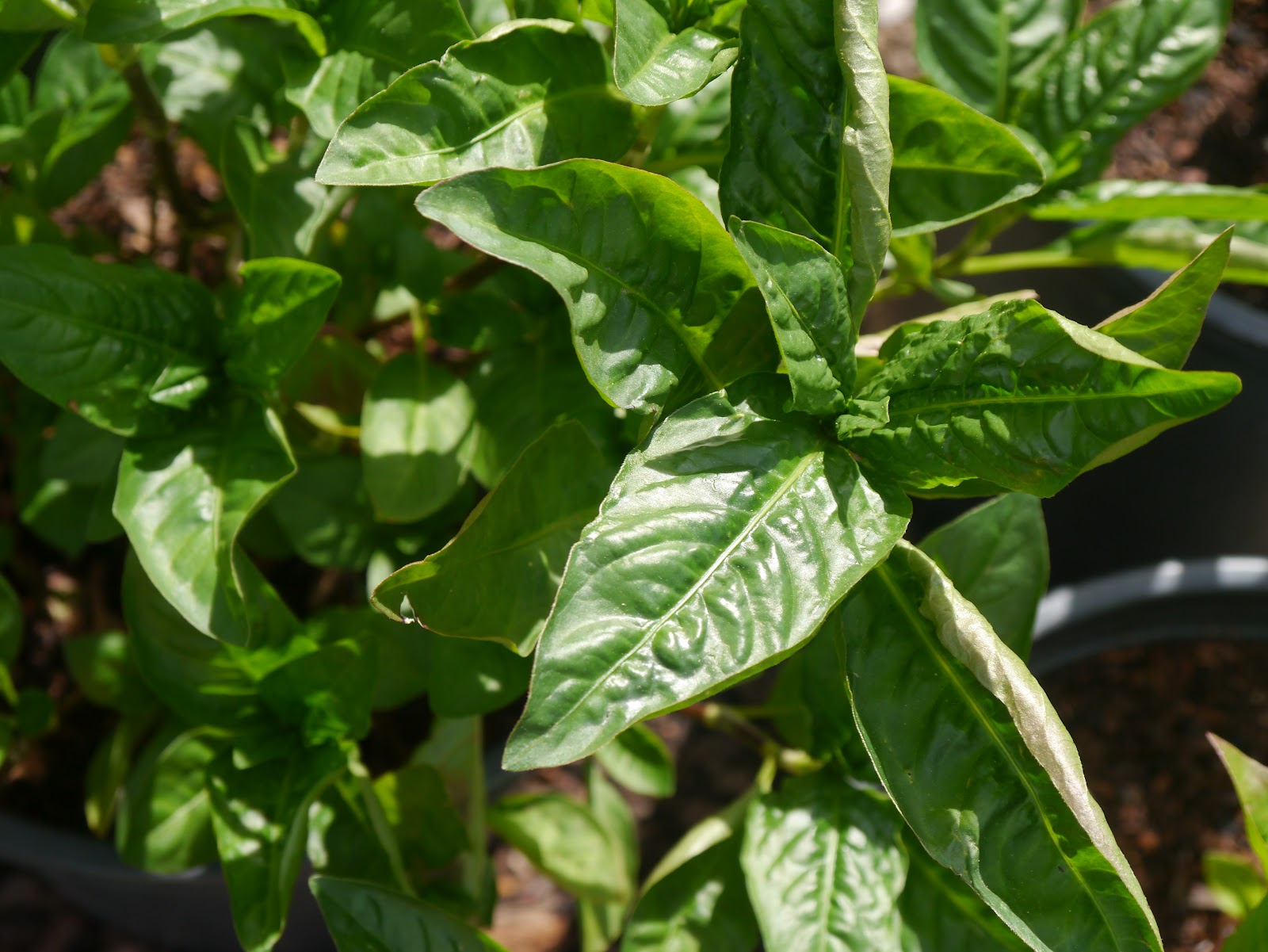
The Indigo plants I've been rearing are getting so big and robust, their leaves glossy and turning dark, I can barely contain my excitement. When they start to develop a blue tinge at their edges, and burst out purple blossoms, it will be time to harvest, maybe in mid-July. I'm embarrassed to admit I've never grown anything from seed, tending it start to finish, like this, and it is magic embodied. To see a seed the size of a bird-pupil turn into these—it reminds you that we humans know so little, about anything, about the processes of life that we are part of. It is a kind of worship, to tend a plant, to help it flourish. And though I've surely helped these Indigos grow strong and fast, in truth, they've given me much more than I could ever give them. When I embark on the process of fermenting the leaves into dye, I may become a total convert to the art and magic of Indigo-- seed to vat to wool, turning the color of the sky.


We had a hot, dry weekend, and the Indigos reached up their dark green leaves with joy. That's the sort of weather they love. It was a lazy day, the sun fell in through the door and warmed up our small fox-den of a home. Simon found a patch of spearmint up the road, and I gathered an armload to make Moroccan  mint tea, which, so they say, actually cools your body down on a hot day, particularly a desert-dry one. It was the perfect thing.


I've been working on more felt pieces, like the one here, to start a little business called "Thimbleberry Feltworks," I think. I'll post a new page here when I've finished my first set of products.

The following are images from the writing desk and wool-trunk.


This is my Victorian writing box, found by my wonderful Aunt Lisa somewhere mysterious. It is tilted upright slightly, for ease of writing and to minimize neck-hunching. I use it every morning, as the birds sing and the sun gets higher, with a cup of tea. It closes up and locks, and holds papers, stamps, ink containers, ribbons, inside.


Other bits from the desk, my little workshop. The beautiful watercolors were made by my friend Lara.


 Teasel, terra-cotta pot I fired in a model-Etruscan kiln (what a bright bonfire of a blaze, all through the midsummer night!) with a bit of glaze made from materials found on the paths near Spannocchia last summer.


Old postcards, handkerchief, two Madonnas.


This is the home of my wools and yarns, an old Civil War steamer trunk.


She looks like the Lady of the Lake. I wonder who pasted her there, who she is.


The wools are wrapped up in bags, to keep the moths out.


Thursday, May 31, 2012

A Poem about Names

Last weekend, my friend Rachel and I wrote poems and drank chai and talked about wool and sewing and the beautiful loose ends of our lives at a little cafe in Oakland. She describes the whole event so well, with such grace, that you really just need to go over to Gate City Gardener this minute and read the post titled “Real Names and Drop Spindles." There you will find her version of the following poem, and a description of the writing prompt we used, which had to do with names, and used words pulled from a pile in the middle of our table, inscribed and shredded, little strange surprises. Here's to contemporaries and to good friends, to seed-packets full of words on torn paper, to sudden May rains.
Here's my version:


My real name is Starfish.
There is a mandolin somewhere
in me, near the pelvis
it strums and plucks, it
reaches out its starfish hands,
sucking up salt crystals, aching for waves.
Swallowing the world into its heart,
salt-cut and bright.

Yesterday my name was Catch-All.
Star-follicles fell down
at night, near the moon’s growing
belly. They fell into my
clavicle, that small dip, they smelled like
metal and fresh bread. 
The cries of
young scrub jays, hungry, rooting
in the vetch, fell all over me. I
caught the rush of Amtrak down by
the bay in my hands, the wind and
what it blew in the window. The places
you kissed me.

Today my name is Bicycle.
My wheels are twirling, I can go
anywhere I want on my twirling
wheels. My wheels have spokes
and they look like passionflowers
when they open, and they feel like
that opening, sexual and unfurled,
completely mysterious,
capable of fruit.

Today my name is Bicycle.
My wheels are made of Hope and
Dream. Hope has dirt on her hands.
She is a little sunburnt.  She knows where
she is going but it doesn’t have a name.
Dream is covered in the young leaves
of indigo plants. When she twirls the air
fills up with the smell of jasmine and blue dust.
The wind is perfect in my hair. 


Tuesday, May 15, 2012

Making Indigo Dye Out of Words


Welcome to The Indigo Vat, where words and tales and dreams are fermented and transformed into sturdy creations that are green as they emerge and turn blue as they hit the air. 

A colorfast blue dye made from plant matter has always been very rare and therefore very precious. Indigo cakes, wrapped up in string and cloth, a condensed and processed form of the plant genus indigofera were traded along the Silk Road. There’s a reason blue was considered royal, for pharaohs, for kings.

The most mysterious and unfathomable things in the world to us are blue: the sea and the sky. These are places of magic, of power, or of something terrifying: the home of Rilke’s Angels, perched between beauty and terror.

The process of making and writing a story, a poem, a novel, an essay, is like dyeing with indigo. You start with a seed.  You tend it like your own blood. You harvest leaves in the heat of summer. You ferment them in a big vat, mixed up with such things as wheat bran, madder root and wood ash. The lid is on, so nothing else can get in or out. The magic of yeast takes over. The whole mass bubbles and rots and melds, letting the blue pigment out. This is the only way to let out the blue. It starts to stink. That’s when you open it up, stir in your skeins of yarn, your silks, your old white pillowcases. You leave them in as long as you want, letting them get bluer and bluer. Then you lift them out with a stick. When they hit the air, they are green. Then the oxygen begins to act. Breathe. The green turns to blue in front of your eyes. Blue for magic, for the deep mystery of the world, for the source of all creation, for stories told in the dark of night. For our blood, before it hits air.

Stories ferment, oxidize and come alive like this.

I’m growing nine starts from seed of polygonum tinctorium, Japanese Indigo. They began by the heater, then moved to the window, and finally outside, where the sun filled them up and they grew sturdy stems and big leaves. They are still young, only in one-gallon pots. I tend them like babies. The first tiny seedling popped its head above the soil on my birthday. I was taken by surprise at the depth of my excitement. It felt like a holy experience. I’d never tended seeds so closely, with such purpose. The sudden miracle of life itself was upon me, how a seed might become a perfect green leaf and a neck pushing up through dirt, completely and utterly new. The only constant on earth is creation.

So, this is a long way of saying that here on The Indigo Vat I will post my newly “dyed“ stories, as it were, for others to read. They need air to turn from green to blue. Stories and poems need eyes and hearts to consume them before they come alive, before they turn rich and blue as indigo robes.

You may also find here, from time to time, forays into the literal fiber arts— my adventures with natural dyeing, felting and spinning. I believe in a deep and creative reclamation of these traditionally female crafts. So, expect both literal and figurative yarns being spun, cloth woven and dyed with local materials.

Finally, I believe that all writing is rooted in place, like indigo roots in soil. Like the indigo plants growing in my Berkeley backyard, I am not native to this land, but it is my home, and has been since I was born (save a few years on the east coast for college). I think that as writers, as creators, we have a duty to the land we live on, its wild creatures, its redwoods, oak trees, thistles. We have a duty to their stories and languages as well as our own—after all, our earliest letters were based up the tracks made by animals in sand and snow.


These are the Indigo-Seedlings, my magical and mysterious charges. I'll show you more photos as they grow and are processed into dye.