Pine
tree tops
By Gary Snyder
In the blue
night
frost haze,
the sky glows
with the
moon
pine tree
tops
bend
snow-blue, fade
into sky,
frost, starlight.
The creak
of boots.
Rabbit
tracks, deer tracks,
what do we
know.

A few weeks back, my dear friend Rachel Economy and I taught a workshop called "Re-Belonging: Walking the Wild Land, Writing the Wild Words," in which we twined poetry writing and animal tracking into a day long exploration of inner and outer wilds. Beloved Point Reyes, specifically Abbott's Lagoon, was our teacher and classroom. It was fabulous beyond all of my dreaming. I am a writer by trade, as you all know, and yet teaching the animal tracking portion of the day, while Rachel, a magnificent poet, held the poetry-writing, brought me alive in a new way, in a different way, in a way that teaching writing workshops alone has never quite done for me. This was a new alchemy, made so by Rachel's partnership. Isn't it such a relief, sometimes, to realize we are better together than we are trying to steer every boat all by ourselves?

Here's how we described the workshop:
"We believe that the crafts of poetry, story-making, and wildlife tracking share the same roots. In this workshop, we will re-engage a sense of our “place in space,” as poet Gary Snyder says, weaving animal tracking and poetry-writing practices, prompts and skills together to connect our inner and outer worlds. We see this as a tangible, hands-on way to meet and meld inner and outer landscapes, and to find joyful and visceral ways to open back up to our ecological relationships and ecosystem hearts.
Especially in a time of great upheaval and deep grief in the world, many of us can start to shut down our connection with the natural world and with our inner animal, in an attempt at self preservation. Moving back into relationship with ecology is essential to tending to the world. In order to do this in the face of overwhelming global trauma, we need tools and practices that let us into the joy, play, wonder and deep sense of home that is built into our bodies and relationship to the animals, plants, and land where we walk and dwell, a well as the heart that dwells within us. Writing, tracking, reading the land and our place in it- these are some of the most potent and joyful tools we have found to walk with.
As mythologist, wilderness rites of passage guide and storyteller Martin Shaw writes, the psyche does not dwell within us but rather is the land itself, and we dwell within it. Through poetry writing and animal tracking we will begin (or deepen) our journeys to re-root in the bigger community of the more-than-human world."
Needless to say, for you local readers, we will be offering more workshops in the future! For now, I'd like to give you a few knotted strands from the day.

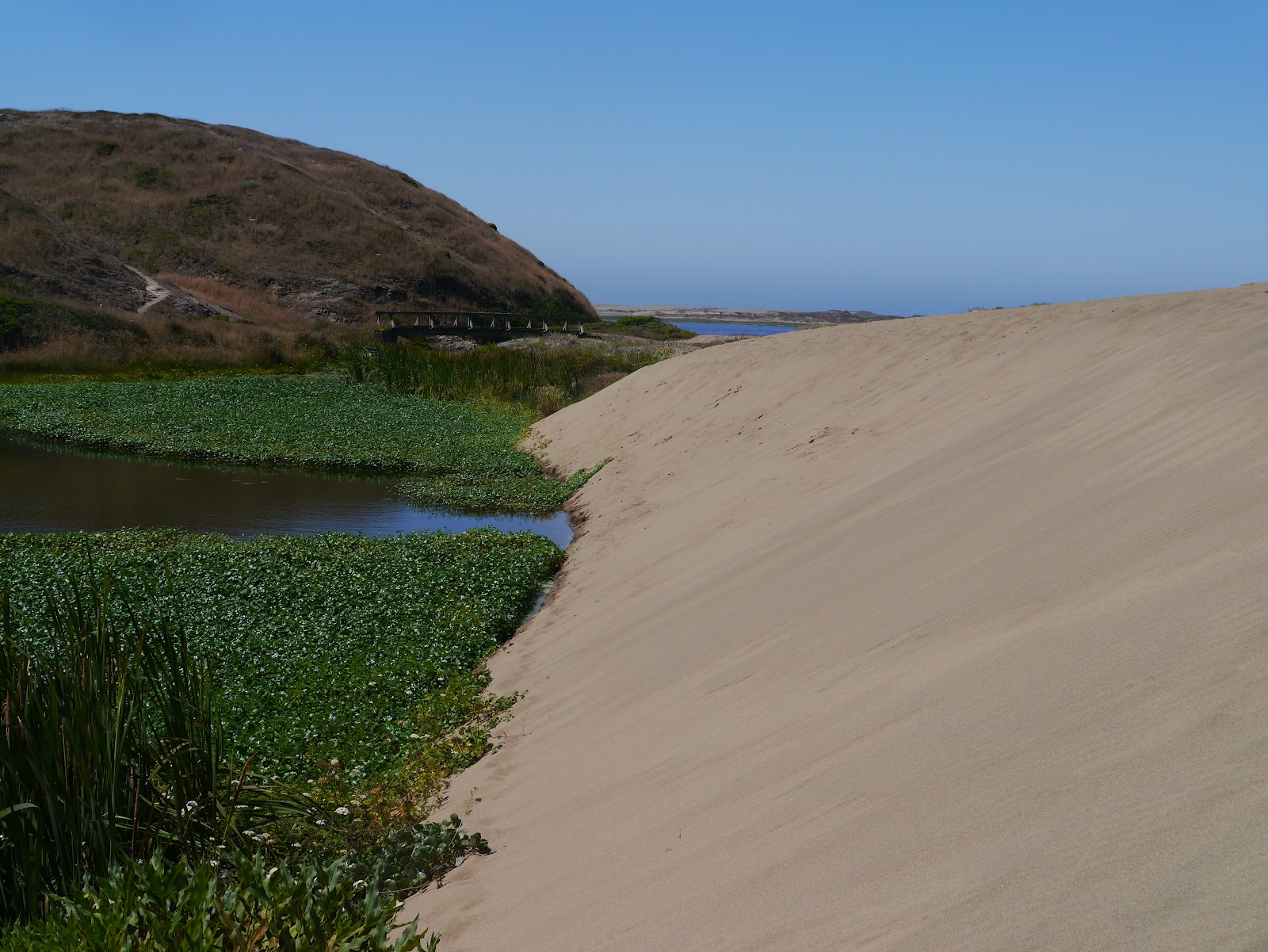
The sand dunes at Abbott's Lagoon are a great, wind-written doorway into a perceptual relationship with the lives of animals—skunk and river otter, bobcat, heron, coyote, deer mouse and centipede. Perhaps more important than this though, they are a doorway into the heart of curiosity. Questions can take on divine weight, and power, when they are born of what I like to call "ecstatic curiosity." Ecstatic curiosity is what happens when you see a bird for a moment, singing in the brush, a bird whose song you don't recognize, a bird whose name you don't know, and the question—who is that?--burns in you. In the lineage of animal tracking in which I was schooled, questions are teaching tools. I might say to a teacher—what bird was that? And he will most often reply--hm, interesting, what bird was that? What patterns did you notice on its wings? What was the shape of the beak? How would you replicate the song?

You have to take the question home with you, inside, like a fresh secret, like a seed you can hardly wait to try to germinate. There's nothing like a good question to get you to learn the answer, and never forget it. A varied thrush!--you will realize one day, in a flash of joy, when you see the bird again, and take better note of the markings, and grab your Birds of the West field guide. It was a varied thrush! You will always know a varied thrush, after this, like seeing a friend.
I like the image of ecstatic curiosity--it makes me think of Sufi mystics, whirling in dervishes through the sand, leaving their own trails, their own spinning signs, of Oneness. Because after all, in my mind, animal tracking is about stepping into the net of Oneness.
Questions are the first doorway. Then, the sand.


A river otter left beautiful tracks along the very lip of the lagoon, showing how it slid down the sand between two gentle blues.


And then sometimes, guesses are completely and utterly wrong. This is one of the wonderful lessons of animal tracking—your ecstatic curiosity is based not on right answers but on engagement with all of your senses as well as the details of the track and sign before you. Of course, right answers are useful and important at some point, because without them you can't really step into the narrative-net of the land around you, not wholly, not with the kind of rigorous specificity that all dedicated arts, and practices of mindfulness (of which tracking, to me, is both) require.
But as a doorway in, as this day was meant to provide, right answers are not as important as questions, as the act of twisting little cords between your heart and the hearts of the bobcats and herons, dunegrasses, sands and centipedes, around you.

Which brings me to a very simple, but very profound thought that knitted itself together in me as we all wandered the dunes, following the weaving trails of skunks, and discussing the gaits of deer--this is the net of connection we all long for, somewhere far deep down, old as our strange big brains, our quick hands.
As some of you know, I've been thinking a lot about the internet recently, and our relationship to it; I said goodbye to my Facebook for this reason. Well, it occurred to me that part of what we crave when we turn to that invisible digital net is not only connection, but also the stimulation of newness, of new content, fresh shiny photographs of things from a perspective that is new to us. And that this desire in many ways seems to come from the same impulse as the place in us that is suddenly overcome with that "ecstatic curiosity" to understand each thread of connection in the natural world around us. This desire for newness is deeply satisfied by every new track--heron, otter, bobcat---no matter how many times those individual animals may have been observed. Every day the tracks are new, the story is new, the world is new. This is the net of connection we have snipped ourselves out of, that we long to step back into; our animal bodies do, anyway, even if our big brains don't know it. This kind of newness, this kind of stimulation, and attention to little details, and ability to hold them all--this is what our brains were made for, not the constant newsfeed updates. This is the original net.
My dad calls it "the outer net," tongue in cheek. The real net. Which of course includes our relationships with each other too, in real live physical time-- for when woven and knotted properly, we are all part of this one big "family of things," as Mary Oliver says. We are not separate; this myth of separateness is what has poisoned us apart.
 |
| Net became the theme for my most recent Tinderbundle |
None of this is to completely disparage the internet; not at all. There is a democratized freedom and wealth of information shared here that is truly miraculous, not to mention the freedom afforded so many artists and makers and thinkers, like myself; I can make a living doing what I love because of this. I have made beautiful connections with other people because of it, and with all of you wonderful readers. For all of this, I am really astoundingly grateful. So please don't misunderstand me. What does disturb me is its addictive quality, the way our attentions, our impulses, are increasingly sucked into this space. I am very aware of this allure as a working writer, when those moments of uncomfortable creative block or boredom or restlessness occur, as they always do, and on the regular—the internet is a very dangerous place for the creative mind during these moments.
What I am afraid of is hard to articulate better than the wonderful Rima Staines did a year or so ago, in her magnificent essay-post, "The Book of Faces and the Web of the World" :
"I have a theory that using the internet occupies a very particular place in us. I think it takes the place of dreaming. Not night-dreaming, but that very shamanic soul-travelling that we all do to a greater or lesser extent when our mind wanders, when we create art, when we day-dream, imagine, journey in our minds and spirits to elsewhere, elsewhen. Internet-travelling uses the same metaphorical muscle I think, but is utterly hollow in comparison because it is not creative in that same sense. It is not magical. And worst of all it replaces the dreaming."
Yes. This is what I fear. That we are letting the internet replace, instead of supplement. That while we busily share and update and take in more beautiful stimulating tidbits than the human mind can possibly contain in a month, let alone fifteen minutes, we are actually taking more and more steps psychologically and physically away from real, sensuous (as in, of the senses) experiences with each other and the net of the more-than-human world that are, in my opinion, the true joy and purpose of the body and soul in this world.

But enough harping. I think I've made my point, and there are better strings to be played. Namely, the soundless music of a group of eight people sitting in the wind and sun and passing of ravens, writing poems sieved through their senses after a morning touching the cords and knots of the net of animal lives on the land of Abbott's Lagoon.
What beautiful poems emerged, I can hardly tell you! Rachel and I sat awed by the words shared around our circle; how this place and its beings had gotten under their skins, and how they had gotten under its skin too. How it is that poems live everywhere, even hidden in the eyes of skunks...

Valentine for Ernest Mann
By Naomi Shihab Nye
You can’t order a poem like you order a taco.
Walk up to the counter, say, “I’ll take two”
and expect it to be handed back to you
on a shiny plate.
Still, I like your spirit.
Anyone who says, “Here’s my address,
write me a poem,” deserves something in reply.
So I’ll tell a secret instead:
poems hide. In the bottoms of our shoes,
they are sleeping. They are the shadows
drifting across our ceilings the moment
before we wake up. What we have to do
is live in a way that lets us find them.
Once I knew a man who gave his wife
two skunks for a valentine.
He couldn’t understand why she was crying.
“I thought they had such beautiful eyes.”
And he was serious. He was a serious man
who lived in a serious way. Nothing was ugly
just because the world said so. He really
liked those skunks. So, he re-invented them
as valentines and they became beautiful.
At least, to him. And the poems that had been hiding
in the eyes of skunks for centuries
crawled out and curled up at his feet.
Maybe if we re-invent whatever our lives give us
we find poems. Check your garage, the off sock
in your drawer, the person you almost like, but not quite.
And let me know.

To close this netted ramble of words, I will leave you with those of poet and translator Robert Bringhurst (his translations of Haida myths are stunning). He explains that the English word for poetry comes from the Greek verb poiéo, "to do" or "to make." He writes:
"Does that imply that poetry is made by human beings? That it only exists because of us? I think, myself, that making and doing are activities we share with all the other animals and plants and with plenty of other things besides. The wind on the water makes waves, the interaction of the earth and sun and moon makes tides, sun coming and going on the water and the air makes clouds, and clouds make rain, and the rain makes rivers, and the rivers feed the lakes and other rivers and the sea from which the sun keeps making clouds, and there is plenty of poetry in that, whether or not there are any human beings here to say in iambic pentameter or rhyming alexandrines that they see it and approve {...}
When words do what blossoming apple trees do, and what stars do, poetry is what you read or hear {...}
Poetry is what I start to hear when I concede the world's ability to manage and to understand itself. It is the language of the world; something humans overhear if they are willing to pay attention, and something that the world will teach us to speak, if we allow the world to do so."
-(pages 140 and 145, The Tree of Meaning)