Showing posts with label reishi. Show all posts

Friday, December 18, 2015

The Inner Rhythms of Winter


Here in the lichen green house all nestled in fruit trees, here in the sky blue attic dormer where the winter stars are clear at night despite the city lights (Orion, the Pleiades), I have been doing my best to move to the quiet and slower rhythms of winter. I love this season. I love the long nights and the frost in the morning. I love the rain (oh god, how I love it) and I love the birds that visit at this time of year and fill the air with sweet notes—cedar waxwings, ruby-crowned kinglets, varied thrush, pine siskins.


I love the lemons, ripening all at once like a thousand yellow morning stars. 

(Says Neruda of the lemon: 

So, when you hold
the hemisphere
of a cut lemon
above your plate,
you spill
a universe of gold,
a
yellow goblet
of miracles.)


I love the way the persimmon leaves (which have now fallen) turn to embers, turn to flame. There is a stillness I find harder and harder to find in this loud and sad and chaotic and bright-screened world, but I have been seeking it nevertheless, as the days dwindle and the light feels more and more like a low and smoldering hearthfire.


There is a savoring of small things through the senses, letting them rest thus in the house of the body, that this season asks of me, and so I am doing my best to listen, and taste, and smell, and feel, and behold. Most of all, to behold. John O'Donohue talks about beholding—how each day we have the opportunity to behold great and simple beauty. It doesn't matter where you are, there is always some beauty to see; it's just a matter of taking the time to see it. I like the world behold, because it is tactile, because it is about holding things inside of ourselves with our eyes. In the Old English and Old Anglo Saxon sense, bihealdan means not only to "hold in view" but to "belong to." I love this—that we can belong to the beauty we take the time to behold. I find that having something belong to me matters far less than belonging to something bigger than me.


Like the winter sun rising low and iridescent across the ocean. 


Like the vulture under a changing sky, riding thermals of rising heat. 


Like the scarlet intoxication of the ancient and magical fly agaric mushroom, keeper of primordial and dangerous wisdom. 


Like the sanddunes under the hands of late afternoon light. 

Once, the vast expanse of western San Francisco looked like this: covered in vast and blowing dunes, some one hundred feet high, where rare blue butterflies lived on the fragrant yellow lupines. Now, the dunes are all a memory, save the brief spit of sand at Ocean Beach; they are entirely flattened and forgotten. This puts sorrow in my heart, to think of the sand and the unhatched chrysalises there under the cement blocks of that place; but it also gives me a bittersweet seed to hold close; that by learning, and remembering, we keep the sand under the city alive. 


Out at Abbott's Lagoon, where the sand dunes still thrive, the coyotes are courting, dancing across the vast expanses side by side, paw prints tripping close but never quite overlapping, one coyote sometimes veering off in a giddy loop, flirtatious and full of the joy of fresh autumnal air, the gentle light, a beautiful pair of canine eyes...


The bobcats, meanwhile, are hunting the edge of the lagoon for the hapless and plump black coots, a favorite wintertime meal.


Newts are out in merry droves, making their annual pilgrimages from their summer estivation burrows to the creeks of their birth to mate. They walk slow and steady, so deliberate, so unswayed, their bellies and feet flashing an orange warning (they are highly toxic to everyone save the garter snake) that is the same color as the satsuma oranges whose flavor is the flavor of this time of year (and my childhood), and same as the bright skin of persimmons, whose fruit I crave throughout the summer, anticipating their arrival in fall. 


Under my hands there is knitting for various little nieces and nephews. Between my teeth are the roasted nuts of the bay laurel tree, which taste of the land I gathered them from, and of cacao and coffee and popcorn all at once. They are oily, and rich, and bitter, and give you a little zing right to the brain, like you are out walking in a wet forest with cold hands and a bright heart. These, too, I wait all year to cure, and roast, and savor. When the days grow darker, I start to crave them, like the persimmons, as if my body knows just what minerals it needs. The minerals of the dark season, its sweet, its strong, its smolder. 

And in my soul (the food it craves) these days are the words of poets—Dylan Thomas and Robinson Jeffers, Alan Garner (poetry written in prose form) and Ursula Le Guin (the same). And also the brilliant words of hedge-speaking poet Tom Hirons in his poem Sometimes A Wild God, illustrated by the wonderful Rima Staines. 


I had the pleasure and honor of visiting them at the beginning of fall—and there are some very exciting things (in Book Form) afoot, and close to fruiting, but these I cannot share quite yet for reasons you will soon see. Suffice it to say that the story of my adventures on Dartmoor, and this Wonderful Surprise, will be coming to you soon, but not just now... like the very earliest trillium wildflowers of January, waiting to bloom when the time is right.


This darkest time of year is the time to court silence and candlelight. This, it seems to me, is its rhythm, and this is also the rhythm of poets, hence this hunger for their words, which are hospitable to silence, which are cloaked in silence and shadow, all that empty space on the page.

Near Samhain I made a pilgrimage with my aunt to Tor House, the hand-hewn granite home of the magnificent Californian poet Robinson Jeffers and his beloved wife Una. 


It was their hearths that struck me almost more than anything—one for each room in that low stone and ocean-blown home, places to gather when the dark was so great outside that it was its own wild being. Jeffers went out every night to read the stars, to watch their movements as the ocean pounded just beyond the back gate, while inside, Una tended the fire, and played the melodeon, and filled the vast dark with an embered sort of beauty. They made their dreams their own, reads a quote (in Latin) carved into one of their walls; they made their  life to the rhythms of their own souls, and their home too. They did it with their hands, and with their dreaming.


This, to me, seems the way to do it. In the gathering dark, as the solstice nears, truths like this stand out more clearly, like the flame of a candle, stark against the shadows. That which is truly bright shines only more fully when the world goes quiet, and dim. 


In my body, the rhythms of autumn and winter have drawn me closer to bedrock; to earth and mineral and stone. To clay, and the working of it, and the delight of watching animals unfurl beneath my hands, and the wonder of learning about glazes, and the transmutations which occur within the kiln. Really, it is pure alchemy. (As are the roses that bloom suddenly in the middle of December in my mother's garden.)


These dark evenings are good for sewing skirts, and burning frankincense, and peering at the tiny (in)consistencies of the moss stitch. (Not a stitch to knit by candlelight!)


And they are good for dreaming, for letting the mind roam to all manner of whimsical lands, where leverets are raised by Wild Folk in wheeled caravans (readers of the Leveret Letters, when I saw this caravan parked on the side of the road in Bolinas, it reminded me so much of the wagon of the Greentwins, or the Basket-witches!), where such wagons might carry a true wandering bard, or a woman who is part goose, or an old man who can mend anything brought to him, including a lost soul.  Or an even older woman with an apron-full of healing herbs, and eyes with the granite of moving fault lines in them.


Out in the hills and forests of beloved Point Reyes the land offers up a thousand cups of tea to heal both the body and the spirit. It seems to me that such cups of tea must be gathered spontaneously, without agenda, open to what offers itself, and just enough for one pot of tea to be shared between friends-- as my dear friend Nao and I did a fortnight past, while she was visiting from British Columbia (more about that beautiful time soon).  Pine needles and plantain, usnea, yerba santa and tiny new sprigs of yarrow, sipped at the hearth of good friendship-- now truly, what could be better? Beholding the forest and hills upon the tongue, inside the belly; an act of communion. (The pine trees dropped some chunks of resin as gifts for Nao to take back north, for muscle-warming oils and salves like the one below.)


Medicines are curing patiently in the apothecary's cabinet (including the first round of a Reishi tincture from the treasured Ganoderma tsugae I found in the Sierras in August), and hanging up through the house, both for the medicine of color and beauty, and to be used in tea when the mood strikes (the pine). 


Meanwhile, sweet Hawthorn is glorious in his full coat, a great satin cloud, lustrous but needing to be shorn. I feel bad, to leave him ragged and close-cut on the darkest days of the year, but a coat left unshorn is very dangerous for an angora (he can ingest too much, and starve), so I will have to snip away soon. Though a bit stressful when we reach the underparts, shearing Hawthorn has become its own rhythm of stillness and soft words and the sudden bounty of wool in my lap, to be spun, and spun, until I have enough for a shawl. How marvelous-- a shawl made by this kind and wise being, and therefore made in large part of the garden plants he eats copiously-- calendula and radish, nasturtium, borage, lavender, comfrey. What a world it is, that such things are possible! We do not need to look far for magic...


It is dark here now, and time, I say, to turn out the lights, shut the screens, and light the candles. May these darkest nights of the year be filled with tea, and time for reflection, and words that nourish your whole soul, that spark little fires in you made of embers the world has never before seen. I find that making time to cut the electric lights, and sit in the glow of fire or flame, is the surest way to hear the quiet but strong voice of the season, whispering its rhythms. 

May you be warmed, may you find the hearth that is always smoldering inside.

Friday, September 18, 2015

Inside Mountains, There May Be Fallen Stars


I kept thinking, looking at the bare fresh rock of all these granite mountains, what is it, underneath? What is the inside of the mountain? I don't mean literally all that endless dark and seeps of gas and pressure, though maybe I do mean this too; but mostly I mean what is it, the life of the mountain? What does it feel like, beyond the surface my eye can see, to be rock all the way to the center, and trapped bits of light? What is it, that mountains dream?


The Sierra Nevadas seem to do this to a person; shudder your vision out into a thousand bright pieces, so that everything seems very big and old and also full of clarity at once, like the color you feel shot through your body when you jump into a snowmelt lake—yes, I am snow, I am stone, I am pine. Oh god, how could I ever forget? At least they do this to me, turning my thoughts toward origins, toward the source of things, towards the macrocosms of mountains and the microcosms of dead logs, and stones, and the sweet plump bodies of chipmunks. Toward remembrance: that the mountains are also in me, and I am in the mountains, and so are the stars. Heady stuff I'll admit; and maybe it's just the altitude talking, though that in itself is something, how thinner mountain air transmutes the thoughts of a sea-level girl. 

These mountains are the source of most of the water that runs across California, snowmelt coming down like grace through valleys and fields, through culverts and seeps, forty percent of which drains into the San Francisco Bay. So coming here, I come to the headwaters, not to mention the origin of Point Reyes granite. (The peninsula--then island--brushed along the Sierras a hundred million years ago when the Sierras were newborn and made up the edge of the continent, before journeying up to her current position hitched to the San Andreas Fault west of Mt. Tamalpais). 

Being here feels like touching down through many layers to bedrock.


The first night, alone on a rock outside the cabin while my family slept, I sat and watched the full moon, how clouds moving in front of it turned iridescent and vanished like snowmelt. And for a brief but staggering moment I could feel the size of the mountains surrounding me, all that elemental heaving of stone for hundreds of miles in each direction; I could feel their silence and their size, their solemn reckoning of the stars; I could feel something indescribable, maybe just their actual presence, and it quietly astonished me, so that I carried the feeling for the rest of my stay, and watched all of its manifestations closely. 


I saw stars made by the beaks of woodpeckers in silver dead wood, gathered close as the silver constellations that come out by night. And I learned one cold evening waiting with my brother on a boat dock that the first bats seem to come out just when the first stars do; they require the same quality of dark. 


I saw the runes left by beetles, and in them read that the forest floor is one long story of decay and rebirth that goes on without cease, like the rising and falling of mountains. 


This is one of those things you know in theory, and then one day you're walking through conifers, studying the scattering of dead limbs and twigs like the fall of the ancient oracular yarrow sticks of the I Ching—and suddenly you get it; you know?


I love those moments; when suddenly you can see the deadwood turning into a cosy home, turning into food, turning, at last, into baby trees. 


I watched the myriad chipmunks, the golden-mantled ground squirrels and tassel-eared chickarees, marveling at their bustling efficiency and also realizing that they, too, are the mountain. That while a scree slope jutting with granite and blanketed sheer with the green of huckleberry oak may look vast, and elemental, and may suggest a grandeur of feeling to the soul, also every square yard of it is known intimately by some or other chipmunk (not to mention the many tinier beings) who has nosed about each shrub and pine, and knows where the good seeds will fall, and the precise shape of this very huckleberry oak, and how far along its acorns are. 


Knowing this makes looking up at a ridgeline very different indeed—at once expansive and tender and mysterious in ways that are small and homely as well as vast and glacier-smoothed. 


I've more than once wondered at both the abundance of chipmunks and the abundance of conifers in these mountains (trying in vain with my brother to tell the difference between a Jeffrey and a ponderosa from a distance-- up close Jeffries give themselves away by smelling of butterscotch); and then, again, as with the deadwood, the obvious struck—the chipmunks come with the conifers; they are constantly busy dropping bits of cone down from the heavens, and rooting out the sweet little seeds. They are made of pine cones.


And so the mountains are made of pine cones too, which root down in the fall of wood and moss and decay and become trees again, with roots that touch down through the layers to the minerals made by stone. 


I like thinking on tree roots; how far down they must reach to find groundwater, how they navigate layers of rock, how the rock navigates them, how when you look at a ridgeline the trees stand with such patience, receiving the sun and then the shadows and then the sun again; how their whole lives they stand like this, reaching deeper and deeper into the parts of the mountains that we cannot see, and though they stand still, how their existence expands ring by ring like a stone dropped through a snowmelt lake, and who knows when it will touch bottom. 


The juniper is one such tree, and though I don't like to play favorites I believe also that sometimes we have affinities inside, and part of us speaks especially to some or other being in particular. It is this way for me with juniper, and I could write pages on the subject (in fact, I have done, for the November 2014 issue of EarthLines Magazine)— but I will say simply here that this tree, above all others, knows the stones, and the wind that has shaped the stones. She seems to choose to grow where no one else will, straight out of the heart of granite. 


Her taproot may be double or triple her height, reaching straight down in one long pathway to water, to mineral, to the light inside rock. And you can feel this when you lean up against her rough bark, when you huddle close, give her your arms in an embrace; she is unshakeable, an old grandmother who looks you in the eye and says child, root deep and do not be afraid. 


In juniper, I bring the mountains and their silent presence home; how the whole of them is contained in a single dusty blue berry, which the bears covet as soon as they are ripe. I gathered her green tips in bundles, to burn each morning throughout my sea level home; there is nothing in the world like the smell, all spice and campfire and snowpeak, and the quiet of bears too, and granite; nor is there any plant that feels so protective to me, so clearing, so strong. 

Our very ancient ancestors understood this too, I believe. (Below, a bit from my Juniper essay). 

"In at least one very literal instance, a juniper tree really does mark the way to the underworld: the opening to the Paleolithic caves of Lascaux.  The caves were discovered when, in the 1940’s, a young man named Marcel Ravidat found a pit created by a recently fallen juniper. Just below the pit was a vertical shaft leading straight down into the cave. This might seem like nothing more than a delicious coincidence—after all, surely other trees grow near or over other patches of earth beneath which portions of Lascaux echo, and who knows by which route Paleolithic peoples actually entered and exited the caves. But scattered throughout those womb-like chambers, thick with the silhouettes of reindeer and bison, auroch and lion and vulva, were at least 130 lanterns whose wicks were all pieces of juniper wood, soaked in animal fat. A juniper fuse to light the way into the rocky womb of the world. 

There is no way to know for certain what significance those wicks of juniper held for the men and women who painted and likely worshiped deep in those caves. But I would imagine that the wick brought down the shafts of stone and into the heart of the earth, the wick that lit the underworld, was just as important as the animals on the walls themselves, or close—for how else, pray, would you see them, or the caves, at all? Furthermore, many argue that the way in which the lions and horses and rhinos were painted suggests movement, and that a flame held up to the walls, flickering both light and shade, would cause the animals to come to life, and dance. In that case, a juniper wick, afire, would have literally been the animating power, shapeshifting the charcoal marks on the stone into spirits." - The Juniper Tree, Earth Lines Magazine


Juniper makes a pathway straight to the granite source of things, and in this, she is my teacher and my guide on how to live hearty and hale and true, and so visiting the mountains is a pilgrimage too, to leave gifts at her feet and linger long by her heart(h). 


There are many other stories too-- how a weasel almost ran right into my lap, chasing a chipmunk nearly as big as she was (can you spot the weasel up this tree, peeking down at me from the base of a middle-right branch?); how my mother and I saw a mother black bear and two cubs feasting on dogwood berries with their big and hungry paws; how inside the last blooms of the mountain heather, there is still a dream of water, and the faces of stars. 


How all of it—stone, snowmelt lakewater, juniper, bear, heather, weasel, pine, chickaree, glacial talus—is the dream of the mountain, and each one dreams of the mountain in turn.

  
But there is one more gift to show you, yet, one final mountain dream, found like the answer to a question as I wandered down from a lake called Genevieve, a little apart from my family, musing about pines and what it looks like to be still and spacious inside, about the dreams of stones and bears alike, and this path called life, and how to walk it wisely—and then for no reason I looked down to my left and beheld. This. 


He was just laying there, already detached from whatever fallen pine log he'd lived on for many long years, old and a little battered but sitting in wait. Often I am hesitant in my gathering; I like to circle, and say hello, and sometimes I get a no instead of the hoped for yes, you may gather me-- and I am careful of this. But this mycelial being-- he practically leapt up into my arms. Seriously. Much to the alarm of the rest of my family, who are still a little uncertain of the fact that I will, at some point, turn this great wise one into medicine to be consumed. For this is a Pacific Northwestern variety of reishi, that most holy of mushrooms called by the Chinese the plant of immortality; auspicious one; being possessed of soul power; numinous mushroom. This particular species is, I believe, Ganoderma tsugae, which grows off the trunks of western hemlock trees, turning their sugars into its own nourishment, turning the mountain into medicine. 

For several nights, I couldn't let this being out of my sight. I put it beside my bed to gaze upon before sleeping, and inhaled its chocolate-humus fragrance at dawn. And it gazed back at me wisely, smiling a small, sage little smile, saying: see, all the things you need are there right along the path, if only you are looking, if only you let there be room for the dreams of mountains in your heart. 
 

Saturday, December 14, 2013

Decembering: Touching Winter With My Hands


Sometimes, all it takes to bring a small seed of calm into my heart is to lay down my pen and paper and do something simple and tangible with my hands— chop rosehips from the garden and pack them into a jar with brandy, knit, run outside and lay my fingers and my palms against the dirt, sit by the peach tree with my hands against the ground until the first star twinkles out at dusk. This winter-time is stirring up an especially strong and old yearning in my soul for the humble, but deeply vital, sensual pleasures of hand and needle, hand and herb, foot and path, foot and frost, eye and moss, eye and rose-thorn branch, nose and winter air, nose and smell-of- damp-coast-live-oak, heart and living land. These things seem to feed the rooting and hibernating animal part of my body and mind.


I think what I mean is, we live in a highly cerebral, analytical, "rational" world, in a culture that does not recognize that when the cold and dark come, even in coastal California, our bodies and our minds long for quiet, for the restfulness of hands-to-wool, hands-to-root, hands-to-watercolors (regardless of whether one is any good with them, ahem). It is time to take shelter in the hearth of home, to make warmth, to make healing remedies in whatever way suits you—soups, tinctures, songs, baths—to let your hands create while your mind, for a little while, can dream into the dark rootings of the winter world, the winter land.


We've had some record-breaking cold here, frost everywhere in the hills so thick in places it resembles snow. The cold invigorates me, it stirs something old in my heart, it makes me long for rain and for the solace of the hearth after a long outdoor ramble all at once.


And so I have been doing my very best, despite the business of the holiday season, and the business of this wonderful writing life I tend and cultivate around myself like an ever-growing forest of alders all tangled at their bases with nettles and native blackberry, marvelous and blessed and utterly unruly, to keep my feet often against the wild earth, and my hands often tangled in wool, or touching the glass of my tincture bottles, or placing one finger-print in the foot-pad of the coyote.


So here is a little bit of a (patchwork) taste of some of my hand-and-foot-made Winterings...


Out in the hills, the manzanitas, marvels of geometry, of water-preservation, of wine-dark barked strength, are getting ready to flourish with the first big storms. I sat recently for some time, trying to draw and paint these shapes, with frustrating results. But as I grew frustrated over my pencil, and set it down, and lay back against the ground instead, staring at the cold blue sky, I remembered that a large part of painting and drawing (for me) is the act of seeing more clearly what is in front of me (and not necessarily rendering anything of great accuracy on paper...). Hence the photo here of the manzanita leaves, instead of my scratchy painting...


The thorns of the wild California rose are as thick as fur, protecting the tiny wild rosehips, those rubies of the fir and bay wood; the poetry of thorns and the sweetness of those hips together sing out into the dark canyons.


I went out on a recent ramble to see if I might find the artist conk mushroom, which I very recently learned is in the same family as the venerated Reishi mushroom of immortality-herb-fame. Ours is called Ganoderma appalatum, and doesn't look a whole lot like the glossy red Asian Reishi. It is a bit more humbly rough around the edges, and, as I realized, is the mushroom I've called, my whole life, the fairy-ledge, not knowing any other name for it.

Although it is not considered as potent as the "official" Reishi, (Ganoderma lucidum), I believe very strongly in the magic of the plants who we share our homes with, our wild ecosystems. We of the Bay Area, and of California, share the air, we share the wind and rain and sun and specifically storied climate, slope, creek, of this place with the artist conk mushroom; we share the stories of gray fox and winter wren and red-shouldered hawk and mountain lion; we share, somewhere, even our dreams. I like to imagine dreams drifting down through our floors, through our house foundations, into the earth, trailed behind tunneling moles, passed off between earthworms, swallowed by hermit thrushes and robins, shat out again at the base of some bay tree, seeped into the soil by rain, taken up into the hard gills of the conk mushrooms...


I didn't gather any at our first meeting; I wanted to just sit, and take the hardy conks in with my senses, and my hands— the fleshy underside is as soft as the finest creamy velvet. This is potent immune medicine, medicine for the nervous system too, grounding and healing on many, many levels; next time, I will come with a little gift to leave the mushroom-folk and the bay-tree sisters from which they seem to enjoy growing... And then I will report back about the making of medicine!


Satsuma tangerine time is upon us here. The orange and lemon trees on the streets are heavy with fruit. Breaking the skin of a tangerine with my nail, peeling it in one S-shape, eating the fruit in one sweet bite, is one of the old childhood smells of winter to me. I've eaten copious amounts of these jewel-sweet planets of citrus in the past few weeks, while feverishly writing out the latest Chapters of the Leveret Letters....

I am reminded of one of my very favorite Pablo Neruda poems, Ode to the Lemon, and the very last stanza:

So when your hand
Squeezes the hemisphere
Of the cut
Lemon onto your plate,
A universe of gold,
You have poured out
One
Yellow cup
Full of miracles
One of the sweet-smelling nipples
Of the breast of the earth,
A ray of light that became a fruit,
The diminutive fire of a planet


On another of these wintering-rambles, squeezed in between tale-writing, when I intended to be looking for the tracks and signs of animals, I got quite waylaid by the beauty of bay laurel bows, eucalyptus and bracken fern, monterey cypress, sword fern, coyote brush, and went a bit overboard gathering bits for a wreath for the door, woven through with a few madrone berries, a few hawthorn berries to bring protection to our home, and clusters of the red berries you see above, whose name I don't know (anybody know? They look like our native toyon, but are not! I think perhaps an exotic plant?).


I love that every time I come home now, this moon-shaped wreath of clippings from the wild hills, where the coyotes roam at dawn, is there to hitch my thoughts and my heart back into the forest.


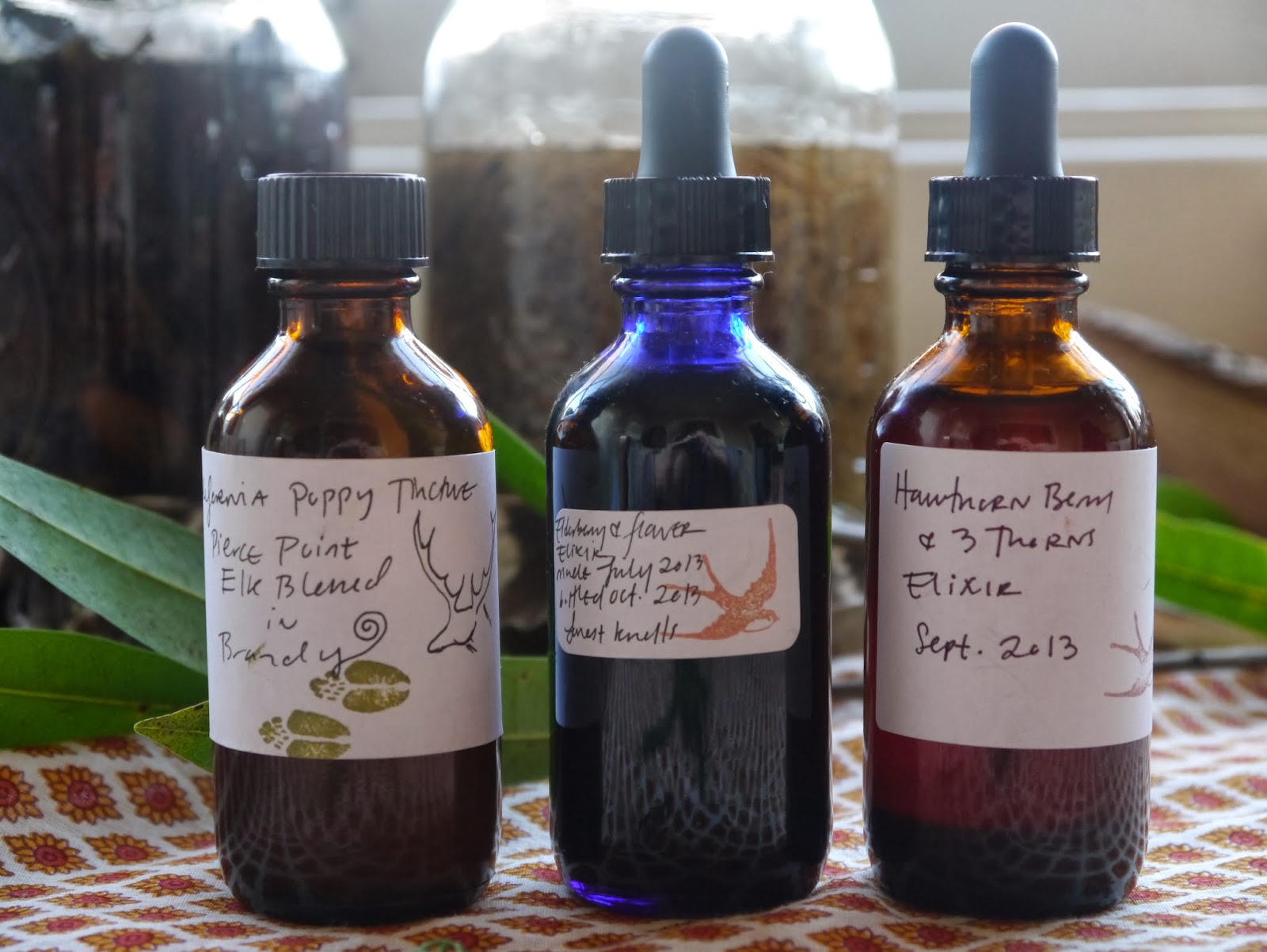
I've finally gotten around to labeling many jars and bottles of medicines made in the summertime. These jars of alder-bark and usnea lichen fill me up to the brim with joy—just looking at them, giving them a shake, thinking of the places they were gathered from. I think this must be part of the healing of plants—the relationships you form with them, the places they come to occupy in your heart, growing forth from there as well as the ground.

(And for you herbalists out there-- I know, my alder isn't quite all the way covered... some of those sticks won't go under! But I shake it frequently, never fear!)


Here are a few samples of the tinctures made over the last six months-- my very first batch of medicines, a delightful harvest on the shelf this wintertime!


And the Bavarian Cough syrup I mentioned some six months ago (!), in this post , has also finally gotten its proper label. Good heavens, it is so delicious I am often tempted to eat it for dessert...


I believe that our hands have an intelligence all their own. How else is it that the hands remember a piece of music on the violin when the mind does not? May your hands make small winter magic this cold and quiet time of year. May your hands, stitching or stirring or sketching or stroking plant leaves or strumming instruments or scattering seeds (if you live in California...) or stalking deer through the thickets (that would be your feet, I suppose) bring just a little bit of solace, and rest, to your busy mind this wintertime, so that it may have a moment, or two, or twenty, to drift and to dream.

P.S. For some more thoughts on the need for quiet and gentleness and dreaming through the winter, read this by wondrous herbalist and owner of One Willow Apothecaries, Asia Suler.