Showing posts with label family. Show all posts

Friday, July 11, 2014

The Four Elk of Old Cotineva Ranch

At the end of June, I spent a long weekend up the coast in Fort Bragg for a family reunion, from which area (the Mendocino coast) my father's side of the family hails, all the way back to my grandmother's great grandmother, Mary DeVilbiss Lowell, who arrived here in the 1860's in a covered wagon train, recently widowed by the Civil War. 

This year, I got to walk the songlines of some of my ancestors along the Mendocino Coast. My grandmother drew me a family tree (which she'd written about to me several times, but which I still couldn't keep straight!), and with my parents and my brother, I set off to find in particular the old Cotineva Ranch, 1,000 acres that reached right up to the Pacific tideline somewhere north of Westport, which was originally owned by Mary Devilbiss Lowell, then her younger son George and his Irish wife, Ellen Roach, parents of my great-grandmother Edith, who was known as the best bareback horse-rider in Mendocino County, and who grew up on that ranch full of fruit trees, sheep pasture, cows. It was a place so beautiful and beloved to her that after her father died when she was still a teenager, and the land passed on to a less agriculturally inclined brother (I believe!), she couldn't bear to go back and see it un-tended. 


First, we stopped in Westport, and admired an old white house right along Highway One that looked out down the coastal bluffs to the ocean. Later, my grandmother said—why yes, that's the Phee's old place, my cousins! Naturally. I soon realized that there were family houses all over Westport, a town which was once a thriving lumber port, and which now is a very lonesome haunting place, made more ghostly by the pall of illegal marijuana plantations deeper in beyond the hills.

It is a beautiful place all the same, and human history a complicated, layered thing: at once I long for the past of my great-grandmother riding bareback on the coastal ranch of her childhood, and her mother, grandmother Mary, and on down the branches of the family line, before Westport became a haunting husk, and yet I know that their lives here were predicated on the abuse, the destruction, of the native people who loved and tended this land before them with more grace and dignity than any of us can hope to replicate.


And even so, to see the grave of my great great grandfather Patrick Roach, buried right beside his wife Kitty Purcell, in a sweet little graveyard overlooking the ocean, California poppies blooming above them—this moved me deeply, as did all of my encounters with family places that day.


Down the street from where my great-Aunt Teresa (really my great great Aunt), the youngest sister of Edith (who was one of fifteen!) lived, bluff and beach (up to the tideline) that were once owned by Edith's husband, Buster Stanley (are you lost now?), are now protected wild-land. Thank goodness. Nobody should own a beach; and yet that was how the world worked then, and it is that said Buster loved this land with all of his heart.


My brother and I stood on the bluffs, looking out over this great maze of rock and foam, as cormorants and oystercatchers wheeled and called, and laughing, said, well of course, it's no wonder this is my favorite sort of landscape. Both of us, the same love for a wild coastal California shore, that particular slant of bluff, the grass gone gold, the firs dark green against the hills to the east. We both felt it stirring in our blood, a shiver up the back of the neck. Maybe land stays with us, somewhere, especially land that was loved.

We kept driving a good fifteen miles or so up the windy One, until it headed inland, east, where there is a great break in the ridges. That's where the Cottoneva Creek meets the ocean. The creek was also called "Cottonwood" by early settlers, of whom A.J. Lowell, Mary DeVilbiss' second husband (and therefore not a blood ancestor of mine) was the first. This fact of course gives me some unease, because naturally there were other people there, the people who named the creek Cotineva, which in their language meant "low gap." I take this to be a reference to the low-point between the ridges created by the creek-valley. And what a nourishing place it must have been for those First people; a lush, alder-lined creek thick with fish, that lead right to the prodigiously bountiful ocean.


In any case, we drove along, beyond that "low gap," looking for a sign for Rockport, which was to be our indication that we were nearing the old Cotineva Ranch. Suddenly, out the window, I spotted this:


Of course, dear readers, you can imagine my excitement, given my general love of elk, and my current project, Elk Lines. In fact I made some sort of bellow from the back seat and yelled to stop the car! There was nowhere to stop, and though I was in something of a froth in the back, we kept going, until we reached a very big bend in the road which my grandmother had said would be the sign we'd gone too far; the ranch was all the land south of the bend in highway One, where it goes inland to meet highway 101 (the old Camino Real). So we turned around, and then I remembered the satellite image my grandmother and I had looked at on google-maps (yes, this song-line travel involved not only oral history but satellite technology)—a long, thin patch of land beside the road that was the old pasture.


We returned to the place of the four roosevelt elk, because they were grazing at the fenceline of the Old Cotineva Ranch. Yes indeed. I could hardly believe it; I was downright shaking when I got out of the car and went toward the elk. In fact I could hardly bear their beauty, and the beauty of the land they grazed. I could imagine my great-grandma Edith, who I never met, riding between pastures, and I wanted to cry. The elk grazed just beyond the beautiful alder forest lining the Cottoneva Creek (not cottonwoods at all— this must have been a misinterpretation of the native word on the part of the settlers). I have a particular love of alders. In my favorite patch of them nearer home, at Muddy Hollow in Point Reyes, elk abound, rubbing them red with their incisors and antlers, leaving their enormous hoof-prints along the muddy creek. I felt a dizzy mirroring, standing at the shore of this land, guarded by alder and elk. 


An old house still stood, and several sheds, just where my grandmother said they would, all looking as though they were about to collapse into the earth. My brother went up to investigate while I stood gaping at the elk, and returned rather shaken, having walked right up to the windows because he was certain the place was abandoned, only to see a mattress, a blanket, chairs. I had to be dragged away from the elk, and the alders, and the sweep of meadow, before anybody noticed us parked right by the house—and me bouncing about giddily after the elk with my camera no less!


Across the road, the property extended beyond a "No Trespassing"-signed gate. I suspect that the pathway you see below is the one my grandmother spoke of, which led to the little family graveyard and then down the ridge to the ocean, where her mother's family, and her father's before them, sea-fished, gathered abalone, sent boatloads of sheep down the coast to market. I wasn't quite brave enough to jump the fence without being sure it was the right one (family have rights of passage to the graveyard), knowing this to be the sort of place where people really don't appreciate trespassing, but I hung over the rungs for a while, dreaming.


Elk and alders, fir forest, ocean and coastal meadow, old families, old ranches, the native stories held deeper and older within the land; well, it turns out all of these things are woven deep into my Elk Lines too, and not on purpose! Though perhaps it is not an accident either, but rather by some need in the heart and blood, some path the body and the mind follow along with the writing hand. So if you haven't yet subscribed, and would like to, click on that handsome fellow above (who is part of a wee surprise for Elk Lines subscribers upon receipt of their first installment!), or this link here.  Subscriptions are open until July 21st for the first installment, which will arrive by Lammas, August 2nd. 

I suppose I didn't know it, but in walking the family songlines that day, I was also walking the elk lines. And whatever the case, I stood so very close to those elk with their antlers all in velvet that I could hear them chew and snuff the air at one another. They looked me in the eye, wild and gorgeous beyond all words, and I will not be the same again, for that beauty, and how they regarded me with gentle, ungulate unconcern, breathing softly, utterly confident in their velvet strength. 

Saturday, July 13, 2013

Mendocino Town of Occult Nasturtiums and Kindly Ghosts

My great grandmother Edith Irene DeVilbiss grew up on this Mendocino coastline, outside a little town now called Rockport (then called Cotineva). She grew up on a sheep ranch that ran down to the edge of the ocean, and rode through those coastal prairie bluffs with her long black hair flying.  Highway 1 went right through the ranch, with orchards on one side and a way down to the ocean for surf-fishing on the other. At my yearly family reunions, which are held about 15 miles south of Rockport outside the old town of Fort Bragg, where my father's mother grew up (and my grandfather just a little ways inland, in the redwood-rimmed town of Willits), it's always repeated that Edith was the best bareback horse-rider in Mendocino county, and the prettiest, too. I've always felt a special love for this wild coastline, and for sheep, and riding bareback, which I haven't done in many years... so maybe it gets passed on in the blood! As well as the obsession, from an early age, with Irish-Celtic music, story, animistic lore. Black-haired Edith came from a thoroughly Irish mother (both of her mother's parents were from County Cork Ireland), and a French-Swiss-rooted dairy farming father... perhaps it makes sense!


I have been reading a most brilliant novel by Brian Doyle called Mink River, set in a small coastal town in Oregon. It is pure magic, something like Dylan Thomas's Under Milkwood, which is one of my favorite things, period, but in a landscape very similar to the wild northern coasts of California (all except for the redwoods, which are only through the very southern tip of Oregon. But the alders, the Douglas firs, the thimbleberries, the salmon, the black bears, the bobcats, the salmonberries, yes). And as I've been reading it in big delicious inhaling bites out on the back porch in the firshade with my morning tea, I've been thinking about the beautiful old town of Mendocino, up on the coast near where my great-grandmother is from. I was just there a few weeks back, around the solstice-full moon, for the annual family gathering, and spent an afternoon wandering the summer-misted town.


It has always felt so deliciously full of story to me, all these old structures preserved and nurtured into the 21st century, a thing that does not happen generally in this country. My grandma Teresa (daughter of Edith) has seen the town of Fort Bragg transform dramatically since she was a girl— a Chevron station in the place she lived as a child. The "old town" of Mendocino has been historically preserved on purpose, and thank heavens for that... When old buildings are allowed to stand, old stories stand with them, and places keep their layers, their many ragged skirts, their wild berry bushes. In any season Mendocino is full of vibrant blooming plants, because of the year-round ocean fog.


This is the kind of place I think of when I read Mink River, when I imagine the community in Under Milkwood. Everybody held together by the seasalt fog, the gray foxes nesting out in the wild mustard grass, the ghosts of old covered-wagon pioneers and Pomo medicine ladies roaming the cemetery at dawn.


I imagine little girls making stews of nasturtiums in the side-garden and playing make-believe: that heart-hole in the fence, if you look through it you'll see a fortune teller wearing a dress made of ocean waves; no you'll see a knight but he's also a coyote like that one we saw last week and his sword is made out of rat bones; ew that's gross, no I think there's a lady wearing a big fushcia for a dress and she has a pet bumblebee who flies next to her and knows all the gossip of the whole town. Mm, says the other girl, that's nice.


And here, at the bakery, the owner has put up sheets instead of curtains because she likes how crisp and  sturdy old cotton bedsheets are, the kinds made by hand half a century or more ago. And really behind those curtains though it appears she is only making croissants and morning buns and scones she is in fact also, in the wee hours when only a baker is awake and the whole town dark and quiet so that the sound of the ocean is very big, she is also making little dolls out of dough for each person in the town, piece by piece finding the right scraps and berries and thorns to make them with. Not to poke with pins and cause pain, no, but to heal them, to keep people from getting sick. And so for a whole generation, nobody does, not a even a cold...


In the peaked tower above the health food store, which is housed in the red chapel, lives a family of mourning doves and the ghost of a little orphan boy named Samuel whose father was a logger. Samuel has a ghost-pet, a marten, from the big old growth forest where his dad worked and took him out one day, the day of the Accident. Samuel is a nice ghost, though his marten sometimes goes out at night and steals pieces of people's slumber, so for a moment their dreams are full of the sharp crack-snap endlessness of an ancient redwood, falling and falling. Samuel likes the sad cooing of the doves, and the doves like how gentle his hand is when he touches their feathers, just like fog.


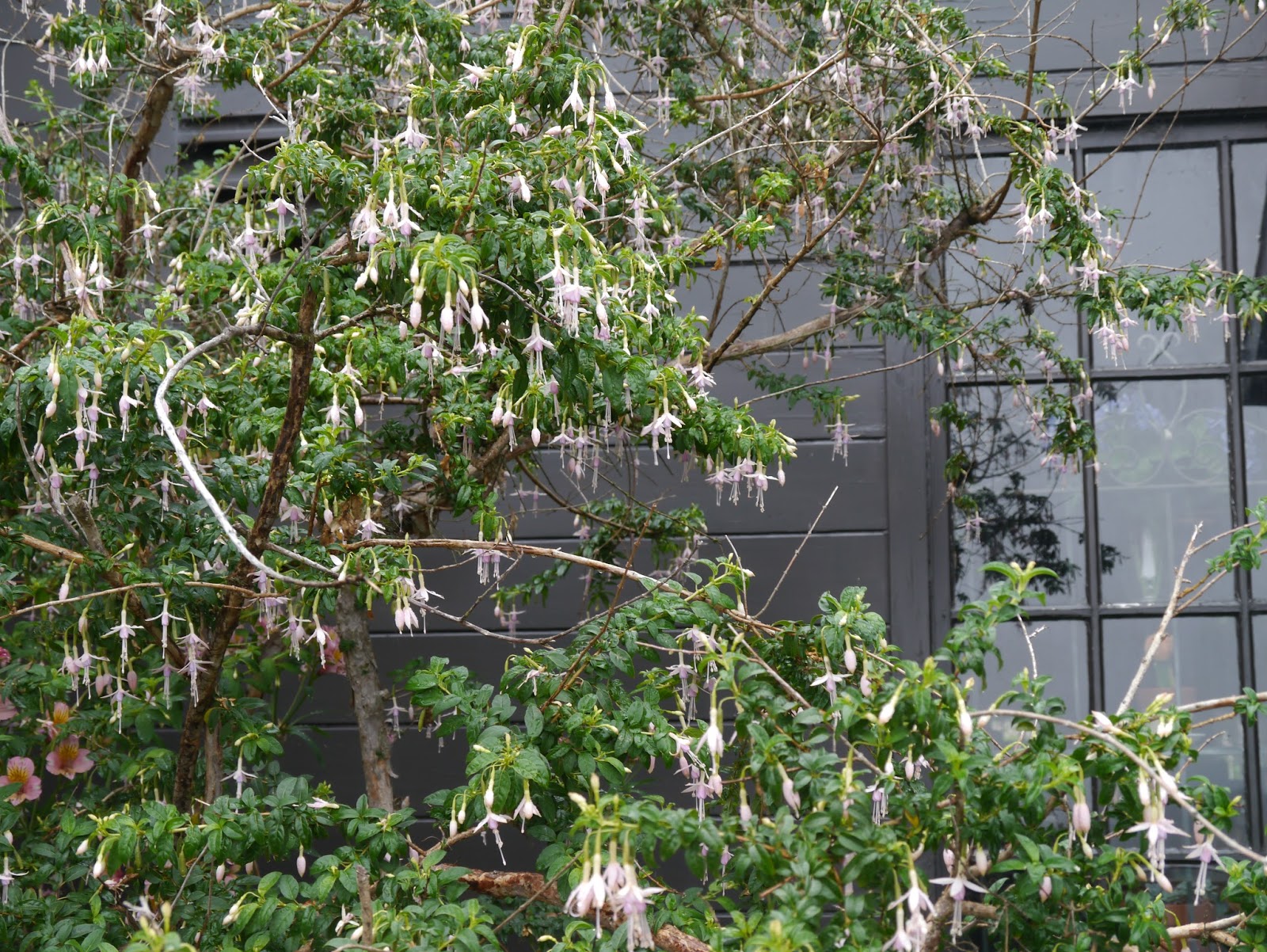
There's a boy in the highschool, his name is David, and he won over the prettiest girl, the quiet one always down at the ocean at lunchtime, who none of the other boys could figure out, though they thought she was quite nice on the eyes, and made jokes about her, because one day he stole a whole bowl full of these delicate white fuschias from outside the fancy jewelers where only tourists went, and strung them into a crown clumsily with his mom's thread and a needle, and gave it to her. Well, they called him a sissy after that, the boys did, during gym class, but David knew he was the luckiest out of all of them.


Of course those boys are the same ones who make jokes about the wooden lady's round breasts. Little do they know, as they smoke cigarettes and share a bottle of whisky in a paper bag roaming the empty streets at 3 am, while the baker, unbeknownst to anyone, is baking little perfect dolls of every last person, that the wooden lady can actually hear them, and is laughing to herself. Little do they know that she could consume each one of them with a single kiss, if she were only human. Instead, she busies herself eavesdropping on the guests who come to stay below her perch in the remnant watertower. She has picked up a lot of stories by now, and even more arguments, but if you stopped to ask her, she would only tell you of the very bawdiest or the most tragic.


Meanwhile, the matilija poppies are opening into the heat, the fog, the heat again, flanked by the blue islands of borage flowers. These poppies have much medicine in their bodies for sunburns, for rashes, for soothing any irritation in the inner and the outer skin...They are languishing under the feet of bumblebees. They are carrying on the honey of the world. They are trading old recipes and secrets with the foxgloves, whose knowings are sharp with poison, and vast as the orbits of planets.


The blue house at the edge of the town sits quiet and patient. Nightly he is lapped by ocean fog, and is often re-painted because of the salt-damage. Personally he prefers to be peeling and crystalline. That way little insects come to live under the peeling paint and then small birds follow to eat them, chipping, talking to him. He enjoys when the woodstove is lit in winter, and when the little feet of children run across the wood floors, or when they leave nose-smudges on the windows, or drawings made with fingers when steam from the kitchen has fogged up the glass. 


And finally, the ocean beyond the wild radish and hemlock, she sings nightly, she sings daily, her big waves full of foam and driftwood and kelp and the cosmological theories of sea lions, who have quite a lot of knowledge about the deepest depths. She holds the town in her fog, she gets into everybody's minds when they are falling asleep, her salty ancient tunes, her old crab-riddle heart.

*   *   *

It is good fun to wend and weave and sing my imagination through this old town I've visited so often since I was a little girl. Perhaps my great-grandmother Edith is singing there too, in my blood. When we start to imagine each thing as somehow living, even houses and streets and pieces of wood, each thing with its own stories, the whole landscape around us becomes so very magical, and very enlivening to the heart and mind, because I think we long to be in conversation with the whole world around us, and not just with ourselves, in our heads!