I am back home now, in the hills overlooking the San Francisco Bay, with fog at our doorstep in the morning, the light getting long and golden, the towhees chasing each other along the fence tops. But I wanted to share a bit more of the deep blue wildness of the Canadian Gulf Islands, and the big one, Vancouver Island, so stunning to look down upon by airplane as I left that it almost made me cry-- green ridge beside green ridge beside green ridge, steep and sharp and feral, what wonders of plate tectonics were at work there, I do not know. It is land, falling away into ocean, cracked and patchwork, ragged-edged, tree-thick, still wild.
The water between the mainland and Vancouver Island is an deep and luminous blue. Orca-full, seal-slick, a blue deeper than skies.


On Salt Spring Island, smaller Douglas Firs and madrones grew right up to the edge of the water. I wasn't used to this abrupt transition between land and sea-- barely a beach, just a drop away into blue, where herons hunted and seals sometimes showed their selkie heads.


Our last morning on Salt Spring Island, bright and early, we climbed to the tippy-top of Mount Erskine, a steep climb through sunrise-orange madrones, then Douglas fir forest growing straight out of a luminous green moss.

Along the way, one or several blessed souls have created "fairy doors" in the rocks and stumps. When you see the moss, and the stillness, of this peak, you can understand why.


Walkers leave offerings-- from pennies to plastic trucks and pieces of gum. Perhaps they leave wishes, too.


Even the mountains were blue on Vancouver Island, as we drove up north in a little red car with a kayak on the roof, banana-snacks on the dashboard, and a cut-out photo of Callie's much-missed cat to guide our way.


Autumn came in on crisp cold footsteps through the blueberry fields at night, from out in the forest, in the fur of black bears, where she lurked and sang. In the little cottage where we slept (between blueberry picking shifts), we stoked the woodstove high and hot. My bed was really right next to it, and I loved the feeling of it being so hot I only needed a sheet. Of course, by 1 a.m. or so I was freezing again, but it was delicious-- the heat of a woodstove, Canadian pear cider, the words of magician-writer Catherynne M. Valente to lull me to sleep.... I've never lived in a home--only visited them--with a woodstove, so perhaps I got over-excited in my log-feeding. But, truly, there is such magic to fire-stoking, fire-warming, the hypnosis of embers, that full-body heat, the gratefulness it fills you with for the bodies of trees.

Blueberry picking shanties were sung in the fields, and accompanied by Callie's concertina when the day's work was over.

The great rift in stone this waterfall made was staggering, breath-stealing, a white foaming roar. It's hard to sense the breadth from this angle, but note that the bare log is at least forty feet long!


There were pools of cold water along a creek on the far side of the falls, surrounded by Douglas firs and red cedars, mossy knolls and clearings that would have been the perfect place to sleep. Dipping in the cold pools of early autumn, your skin comes out smelling like firs.

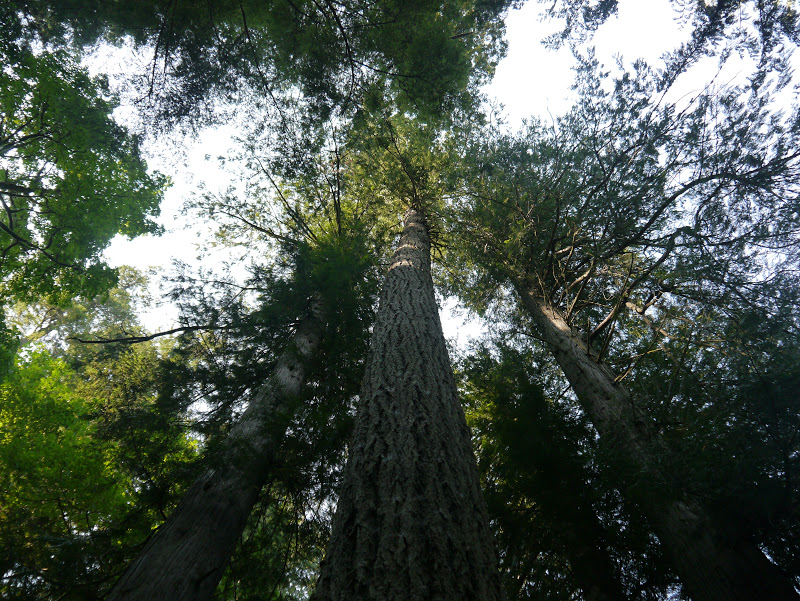

They are big and old up here, turning most of the island-landscape as green as the water is blue. The bark of Douglas firs is a marvel-- rough and rune-etched, it is storied beyond comprehension. And beneath the ground, these trees are all touching at their roots, sending messages to each other via minute fungi who move along those underground pathways like thoughts.
Suzanne Simard, a professor at the University of British Columbia, explains this tree-magic in the following video, which I recently found. It is stunning. Do, please, watch!


These are the roots of a big fallen red cedar, not Douglas fir, but I believe they entwine and send along their commands and their dreams in much the same way. The brain, buried in the soil with the fungi and the worms, the mica and the magma-songs of the crust. It is a holy place, I think, the basket of a tree's roots. (Of course, right after this photo was taken, I discovered I was sitting feet from a wasp's nest, after one flew up into my scarf and stung my chest-- they are guardians of the temple, perhaps...)
It is moving to imagine that one day, the Point Reyes Peninsula, near where I live, hinged as it is against the Pacific tectonic plate, only resting against North America, will drift and rift and buckle its way northwest, past Vancouver Island and its small companions. Perhaps it will rest against them for a while, in that deep blue place, before carrying on, north and north, until it subducts and combusts into the earth, below the Aleutian Islands.

For now, it is nearby, this Douglas-fir forested, coastal chaparral covered, elk-grazed and lion paced peninsula, and I believe I am in love with it (as if that needed stating!). To see new lands is a beautiful thing, but to find roots in a single place-- this is a different kind of beauty, a difficult and profound adventure, a life-long task, really. I'm only just beginning it.


