Friday, February 14, 2014

Singing in the Rains of California

Oh my dear, sweet readers! Some brave, sturdy clouds have at last made it through that great Ridge of High Pressure, and over the past two weeks they have brought us small rain (and then a big rain, of which I shall tell!) like a thousand little glinting jewels strewn through the nasturtium leaves. 

The first morning of wetness—only a couple days after I wrote here of the Drought, in a fit of despair!— barely coaxed the dust to settle, but it coated the clovers and the dead raspberry canes with a silvery glow, it seduced the smells held too long in the leaves and grasses and dirt and tree trunks and even the asphalt roads out again, so that as I road my bike through the morning to my dance class, I kept inhaling, inhaling, until I thought I might pass out with the sweetness of it (and a tad too much air!). 


And as if they had been on the edges of their loamy seats all this time, seemingly overnight, the tiny green ones began to pop, beginning at the edges of the paths and lanes. The sky looked cleaned, somehow.


I had been afraid, deep down in my heart, that maybe nothing would grow this year, that no new leaves would come out— no elderberries! I was half weeping already at the thought, though I know, I know, it is not the worst of the concerns brought by a drought—but the dear fecund cleavers, the fierce nettles, the hardy blackberries, they positively danced, even with their scant half inch of water.


I went walking in Point Reyes, along the Muddy Hollow trail, to visit with the red alders, and the new nettles—I had feared there would be none!—and a special grove of alders that grow close and pale, where the tule elk pass, rubbing their antlers on the bark, where the bobcat moves, out of sight of human trails, coming down from the scrubby hills where she hunts the voles, the gophers, the small birds, like this darling fox-sparrow above, of whom I've been seeing much recently—it is a subspecies known as the Sooty Fox Sparrow that winters in the Bay Area from farther north, and what a sweet gift it is to get to meet them! (For beautiful photos of this bird, see here. I can't seem to quite get over the sweetness of those speckles.) Once, last winter, a wildlife camera (which I helped set up with Felidae and a tracking group called Catscapes, since we tracked bobcats and cougars) near this special grove of alders caught a shot of a lone mountain lion, passing gracefully at dawn. This is a special place, a place of old magic. When I visited it last, it was so brown and gray and dead I felt tight and a little sick in my stomach, a panic beginning to rise in the back of my throat at the hot sky, only blue, empty of clouds, desert dry. But after even two days of scattered rain—so little, in fact, that I heard people joking that the poor clouds were trying hard, but they'd quite forgotten what it meant, to rain— the land began to move, like my own spirit did, and throw its whole heart up toward that water.


I tell you, those weeks of stark blue skies were so unsettling to me (downright awful, though everyone kept saying the weather was so gorgeous—and it was, in its way, in the way any jewel-bright thing is beautiful, but somehow too bright) that after that first speckling of rain, just enough to wet the streets, when the skies finally changed, I positively drooled over the clouds. I've never appreciated them so much as that first day when I noticed them again, big sculpted creatures migrating the skies, nomads from far over the ocean, far over the mountains, changing form as they travel but also somehow always themselves. 


I spent half an afternoon gaping at their shapes, up in our attic windowseat, which I've since renamed the Cloud Window in their honor.


I brought my knitting, and my tea, and my watercolors, and basked in the cloud-light.


They are a gentle relief, clouds. Sometimes the sky is too big and too blue and too bright, and we need clouds to wrap us, to darken our days so that we may slow, and quiet.

At long last, just a week ago, a bigger cloud mass moved in. It came all the way from Hawaii— I shall never think of clouds the same again, after all of my slightly obsessive weather-researching, the clouds great intrepid travelers of our seas and skies, coming thousands of miles, trying to keep the rain held in their bellies—and, dear readers, it was a downpour.


I'd been so grateful for any wet at all, even the tiny gentle drops; any is better than none, I said, but those small tastes of rain wer making me long for the thrash of storms, the release of those clouds, breaking open upon us, torrential. I was filled with memories of big childhood storms, or storms when I was sixteen, and newly in love, and wandering out in the torrents.

Last weekend, that great creature, a Storm, finally visited us.


The radish seeds in our garden burst up through the mud.


The new raspberry leaves gathered, and pushed out.


The cleavers went rampant.


The birds came out in droves, shaking their feathers with what I can only call glee in all the wet, puffed and gloating like this towhee, and like I was, sitting out in it with the raindrops falling down my nose, a mad wet laughing sight, I have no doubt, to my neighbors, holding my hands up to it all.

I went for a walk to the lovely apothecary around the corner from our home, just to have an excuse to walk in it, and came back with the new-blooming violets which I discovered grow in patches right across from the beautiful hawthorn tree I found some time ago growing boldly from a sidewalk.


I tell you, the first true rain got me into a quite a flurry of joy. I put the milk on the stove, I melted chocolate, I filled up the silver chocolate pot, I ascended the ladder to the Cloud Window, I reveled. Really, there is no other word for it. I was meant to be working at the same time, and I did (a little) but mostly I drank a whole pot of chocolate and opened all the windows and grinned.


I anointed my chocolate-shot teacup with a beautiful elixir purchased from my friend, the lovely Asia Suler of One Willow Apothecaries, called White Sleigh, made to stir up all the magics of winter. It was the perfect thing, as this rain, I think, was a magic of the highest degree.


Raising a cup to the rain!

The next day, my love and I set out for Mt. Tamalpais, the beautiful Bay mountain where we both grew up. On that day, Mt. Tam received ten inches of rain— much more than Oakland's 2 inches (the mysteries of microclimates!)— and we were out beneath them, drenched to the bone within about 30 minutes, and laughing wildly. I did not bring my camera—if I had, it would have been ruined! And it was the sort of day no camera should touch, because the heart holds it all. It was a day of frothing rushing creeks, spontaneous waterfalls, getting down on hands and knees in the mud to exclaim over new pedicularis blooms, the trilliums nodding under the weight of raindrops, their white petals going transparent, the foam coming out of the redwood trunks from so much water (sacred stuff, it must be, redwood foam!) Simon has a keen eye for oyster mushrooms-- I never seem to see them until I am three feet away-- and so we came home with several large ones from logs fallen over rushing creeks, from the front porch of a woodrat nest... jewels made from rain and dead wood.


The only photo I captured was the aftermath, as we dried off at Simon's family home up the redwood canyons—and somehow, it turned out like this, capturing the feeling of that gushing rain better than any straight image could have.

I visited the creeks of Mill Valley later on with my father, and while I have no photographs, let me tell you, they were rivers, muddy and flooding and higher than I ever remember them. We stood behind the park where we all used to come and skip rocks when I was small, and crooned at that rushing muscular ribbon of water.


In the East Bay hills, the soaproots are now positively bursting, and the deer know it too. They seem to have munched almost every bunch I've seen!


At long last, not just the sides of trails but whole hillsides are starting to shudder and glow with green grass.


What a blessed sight it is.


New wild cucumber vines have appeared, as if out of nowhere, as they are wont to do.


And last years wooly blooms are at last put to rest.


Everywhere the raindrops look to me like the most precious of pearls, more beloved to my heart than any gem could be, because they coax each seed open once more, and my own heart too.


And bless her, my old friend Nettle, she seemed to laugh at me, and then stung all of my hands in scolding, saying—how could you ever doubt me? I will always return.


I know that California is still in a severe drought. Our rainfall is minimal compared to previous years. I know, the ever cynical News Folk tell us to not celebrate too soon, we still need another ten inches or so to be "normal,"but only two weeks ago, they also said that the High Pressure Ridge wasn't going to budge— and then, this, this miracle of flooding creeks.

So I am hoping, and I am bowing down to the rain, and I am bowing down to the cloud caravans that brought it from far over the ocean. We love you,  I want to say to them, we raise our hands to you and kiss each raindrop-world that lands, a gift, in our palms.

Tuesday, January 28, 2014

Mourning the Rains of California

I am a child of rain, a child of storm and fog and thunder and the smell of a wet road, a wet garden, and oh my, the wet forest—fir trunk, bay trunk, oak trunk, duff. I remember, growing up, that when the rains came, I would dash out back and run around as the grass got muddy, reveling. I would do rain dances in the side garden with an old friend, invoking our own pantheon of water deities inspired by the Egyptian ones. (Once, it even worked!) When the sky started to get a little patch of blue showing through, I would feel upset— go away, blue, keep raining! Keep raining! 

Rain to me has never meant indoor weather, though certainly the book-worm in me delighted (and delights) in the warm evenings by the fireside with my various books (generally, at a young age, chronicling the adventures of various medieval herbalist-animal-speaking warrior-type girls...). It is weather that, for me, demands interaction. It makes me want to throw on my coat and pull up my boots and head straight for the hills. I love the sound of it pattering on the leaves of trees, on the dry grasses as they soak and soak and get ready to turn green again. I love it on the roof at night--few sounds comfort and delight me as much. I love it dripping down my nose and eyelashes out in the hills. It sparks something in me, some kind of fire that sends me dashing and whirling and leaping, perhaps like the roots underground in this drought-prone place, who must surely go into throes of ecstasy when that first big storm comes, who must positively sing as they drink, and drink, like my own soul does.

But this year, as you well know by now I am sure from all the News, no storm has come. 

The dry hills of Pfeiffer Ridge in Big Sur. Just south of this photo, a whole ridge was burned in a bad wildfire in late December. A winter wildfire is never a good sign.
The hills are caught in summertime, an aged summertime that has gone from gold to grey to old-bone grey-brown, ready to catch fire at any second. The air itself is dry, the sky so big and blue it unnerves me. I feel a palpable weight lift when we get cloud-cover for a morning or afternoon; it is winter, it is the time for muted gray skies, for slowness, for dark. As the News tells us, the reason for this drought in California and the Southwest has to do with a High Pressure Ridge larger than the Sierra Nevadas (2,000 miles long, 4 miles high) that has been clamped over the Pacific Ocean for the last 13 months, deflecting storms north and east of us. When the sky is blue and empty of clouds, I can almost feel that pressure-- or perhaps it is just a pressure system inside my own chest, clamoring for downpour, clamoring for release of rain from that silent, too-still sky.

Oh beauty, Oh Big Sur

I know that deep drought has touched California before (though not this deep since around the 1500's, according to geologists and those folk who study historical weather patterns and climate). I know that the seeds of the wildflowers in the ground are not dead, just dormant, even as the hills turn a darker and grayer dry brown than I have ever seen, a ravaged color. I know that heat can cleanse, like a fever. I know that an oak tree has deep tap roots that touch the dark cold waters of the ground.


But my animal body mourns the dry. My animal body craves the change of a season—and for you eastern folk, yes, California does have seasons, indeed, and they have to do with rain, and the blooming of different flowers, and fog, and the migrating of whales and of birds, and so many other things. My animal body has dreamt of running through rainstorms, only to wake and smell the air out the window and know that the sidewalks are dry. My animal body feels grief, it feels great unease that seems to leak into my all-too-human-mind, making anxiety rise more often, unbidden, like wildfire, able to catch light anywhere.


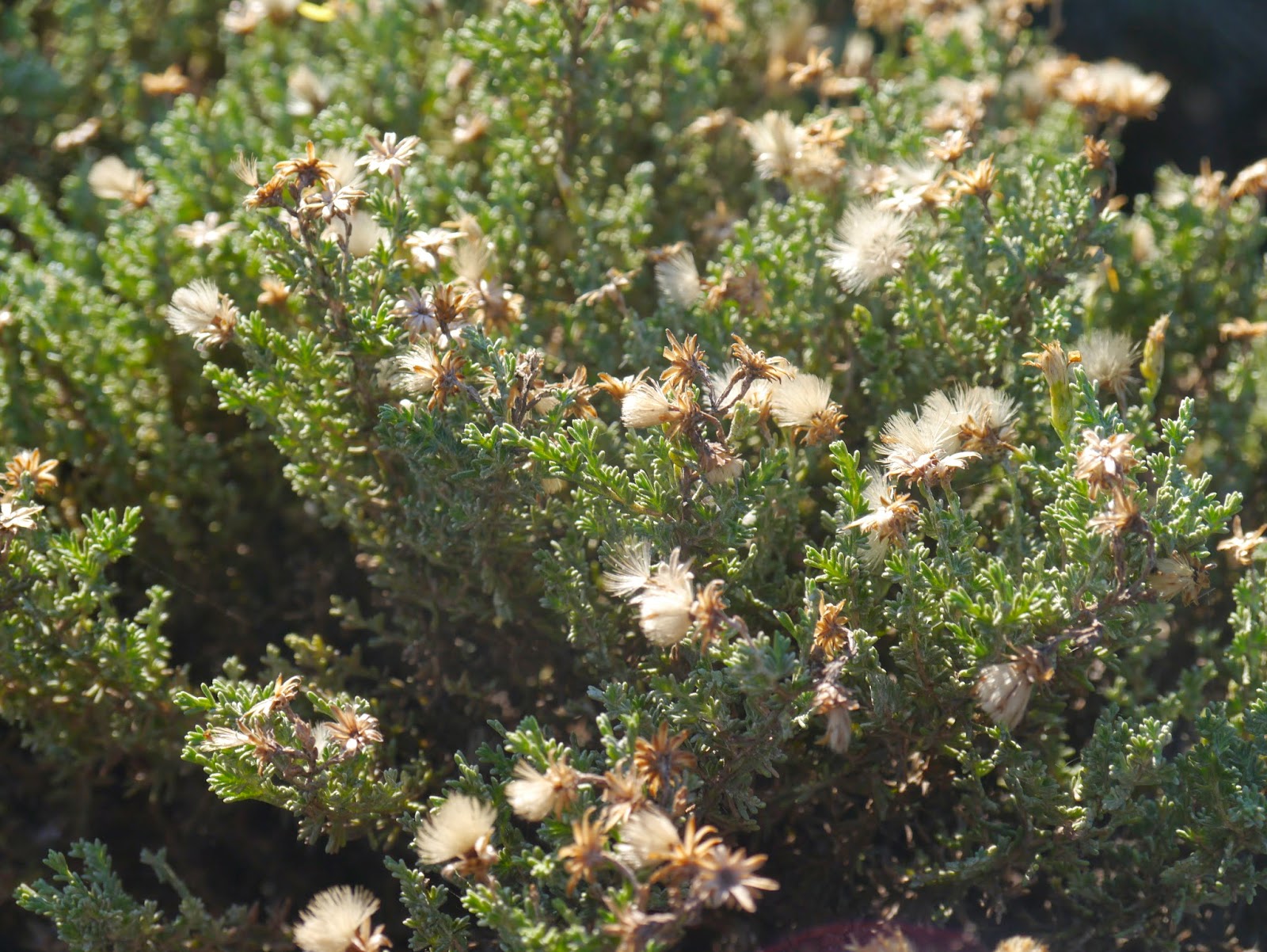
The plants are frozen in time, dry husks. They are wise, though. These chaparral and coastal scrub plants of Big Sur (and the rest of California), like the black sage below, know about droughts in their seeds, in their genetics, in their resinous hearts. They know how to keep water from transpiring off their leaves. They know how to go dormant into the dry times. They smell sweet, and strong, despite everything.


A part of me wants to run north, run toward the rain—some kind of wild and nomadic instinct, to follow the water, to run from drought. And without a doubt nomadic peoples of the past and present did and do just that. I've said to friends, laughing—I may need to take a train to Oregon and go lay down in a rainstorm, to be renewed, partly joking, partly serious. But another part of me, the part that is full of a grief beyond just the "soft animal of my body," as Mary Oliver would say, the part that feels, somewhere sick and sorrowful in my stomach, that this is our fault— that part of me knows that we have to stay with this. We have to stick with it, like the black sage, like the coyote brush, who cannot leave.


I think that it is only through our emotional bodies that we can really access the great environmental griefs of this era we are living through. And our emotional bodies are activated, at least in my experience, by those things which occur right around us, on the land we love, in the air we love, amidst the people and plants and trees and streets we love. Global warming and climate change have been horrifying, sad, frightening but somehow impersonal concepts to me until now. Until this dryness, this drought, which may, it's true, be "just another climate cycle," but really, honestly, let's just be straight with each other here—we've had a hand in this, we know we have. The really bad ramifications of a prolonged drought here— agricultural shortages, massive wildfires, eventual clean water scarcity—have yet to even set in, though I know that our local, small scale farmers are already panicking, and tapping into their ground water, and they, more than anyone, deserve their rain-prayers answered. I dearly hope we can avoid the worst of this. But even now, as I feel the scratchy dry air in my throat, it makes me want to yell. I can feel my rain-loving soul thrashing around, as I search the sky in the morning for clouds.


It has been believed through the ages that a drought was a sign that humankind had offended the deities of earth and sky. Whatever the "true" cause of this one, I think we might benefit from a healthy dose of this sort of humility, this kind of morality, remembering that our actions really do affect the great web of life, from ants to rainclouds, that we have a responsibility to this earth which nurtures us every day—the air we breathe, the water we drink, the food we eat, the blood in our bodies. At this point, of course, I'm not sure a rain dance and offerings of sorrow left out on every roof would do the job. I think we're in a bit too deep. I'm not sure we deserve a mythic solar-hero to go and fight the dragon out over the Pacific who holds the rains in his stomach, and yet I so, so desperately wish he would come along. I think it is a lesson—that we have overreached, here in California, much of which is as arid as parts of Morocco.  That we have built up our civilization in a period of record wet, and while this drought is very likely much exacerbated by global warming, it is also part of California's character to go dry for periods of time.


Despite this calm rationality, I am writing these words because really, I am sad, because I am scared, because I am a lover of rain, because, like a good soft animal, I do not want these cycles of dryness to change the land I love, even though I know the land I love has many faces, and many phases, and part of learning to be fully human is to learn to ride through change, and adapt to it. I am writing this because I do not think we are given the space in this culture to grieve the changes we have wrought upon our landscapes, our air, our clouds, to express the anger and fear and helplessness that we often feel, or repress. After all, when we call most non-human beings "Resources" instead of "Kin," not much room is left for emotions such as sadness, such as loss and sorrow. You cannot mourn a resource. That's why I like the language used in many Native American cultures, such as the Yurok, who called all beings "people"— frog people, cloud people, human people. You can mourn the cloud people, after all, the rain people, the thirsty deer people, the newt people who have had no winter rains to spur on their mating season, the salmon people who can't make it upstream.


At the same time, as naturalist and herbalist Jolie pointed out to me this weekend, it's good to remember that while we may grieve, the plants do know about drought, like this Big Sur succulent above, which has dry and water-conservation and heat written all over it. And the native bunchgrasses may make a come-back this year, she said, pointing to the only tufts of green coming up under the dry grey-gold, which were, indeed, growing in those classic perennial bunches. At long last, perhaps they will have a chance to outgrow the invasive grasses.


In our own tangled and wild garden, the daffodils are already up, and the bees are busy gathering their pollen, and it is hard not to smile at a bee in a daffodil, with pollen on her legs, and the smell of that daffodil up to your nose. It is hard not to smile at the smell of the apple blossoms, so early, the magnolias on the street, the bright yellow faces of the sourgrass exploding everywhere along sidewalk edges.


It is hard not to smile at the sunny calendula, which hasn't missed a beat since we moved in at the start of November. And as my small 6-year old neighbor told me out in the garden as we searched the dirt for worms—if you spray the yellow flowers, and the lemons maybe too, with a little water at dusk, the fairies will come and collect the gold. Well, I thought, well. I do not know what our summer is going to look like, or even our spring, but now the flowers are coming out gold, today, this moment, and so there is always beauty, every day, everywhere. And so we adapt our hearts and our spirits, just a little bit, just enough, because that, also, is what animals do, in order to survive, in order to stave off sorrow. At once, we do not forget to sing out to the clouds, tell them how much we love their wetness when it is poured up us, how much we love the smell of mud, the sound of rain on our roofs, the taste of it on our tongues.  Whether or not it coaxes thunderstorms, perhaps such songs, such prayers, will douse our hearts with a little fairy-gold, will fill our own souls with enough rain to carry on, to make small changes, to look a warming world in the eye, to look our own guilt in the eye, and some make good of what we do, that it may be somehow in service to the land which holds us, even if that service is just a word of praise, said aloud, to a raincloud.


P.S. Nevertheless, Sir High Pressure Ridge out there beyond the clouds, if you are ready, and only in your own good time, perhaps it is time to let go. Perhaps you, too, would enjoy a big thunderous rainstorm come washing, at long last, through your high-pressure spine.